
Free Night Certificates and Overwater Villas: Which Ones Are Eligible
Free night certificates are the most oversold currency in travel. People collect them for years believing an overwater villa is waiting at the end.
Sometimes one is. Usually the rules get in the way first, so let me correct the beliefs one at a time.
Which free night certificates actually reach overwater villas
Hilton’s free-night terms specify a standard accommodation, subject to availability. Compare the room definition and expiry on your actual certificate before planning around an overwater upgrade.
A certificate most reliably reaches an overwater villa when that villa is a standard reward room. Some programs permit a separate upgrade with points or cash, so check the exact terms before ruling out a property.
Everything past that comes down to your program’s cap, whether you can top off with points, and whether certificate inventory exists on your dates at all.
- It works when the resort has no land based rooms, so its base category already sits over the water.
- It fails when the property also has beach villas, because those become the standard room instead.
- Check three things in your program: the cap, whether you can top off with points, and the expiration.
- Certificate inventory is separate from award inventory. A resort wide open for points can be closed to certificates.
- The room is the only free part. Transfers, green taxes, service charges, and meals are all still yours.
- Do not save it for the flagship. The quieter branded resorts release far more certificate space.
Start with the program, then the exact room shown for your dates. A certificate works for an overwater villa only when that villa qualifies under the award’s standard-room rule and is released for certificate booking.
- Hilton: Its Free Night Reward covers a standard accommodation, subject to availability and exclusions. It can reach the water only when Hilton identifies an eligible overwater room as standard for your dates.
- Marriott: A Free Night Award books a standard guest room. You may add up to 25,000 points to its value, but extra points do not turn a premium water villa into a standard room.
- Hyatt: Category Free Night Awards require an eligible hotel and an available standard room under Hyatt’s award terms. A water villa listed only as an upgrade does not qualify automatically.
- IHG: The Anniversary Night has a 40,000-point starting cap with an option to add points on eligible cards; it still requires an available standard room.
Belief: a free night certificate works on any room the hotel sells
Usually it does not. Marriott Free Night Awards apply to a standard room and can be topped up with points, while other programs set different rules.
At a beach hotel that limitation is invisible. The standard room is a normal room and everybody is happy.
At an island resort it decides everything. If the property’s base category is a beach villa, your certificate buys a beach villa and nothing else.
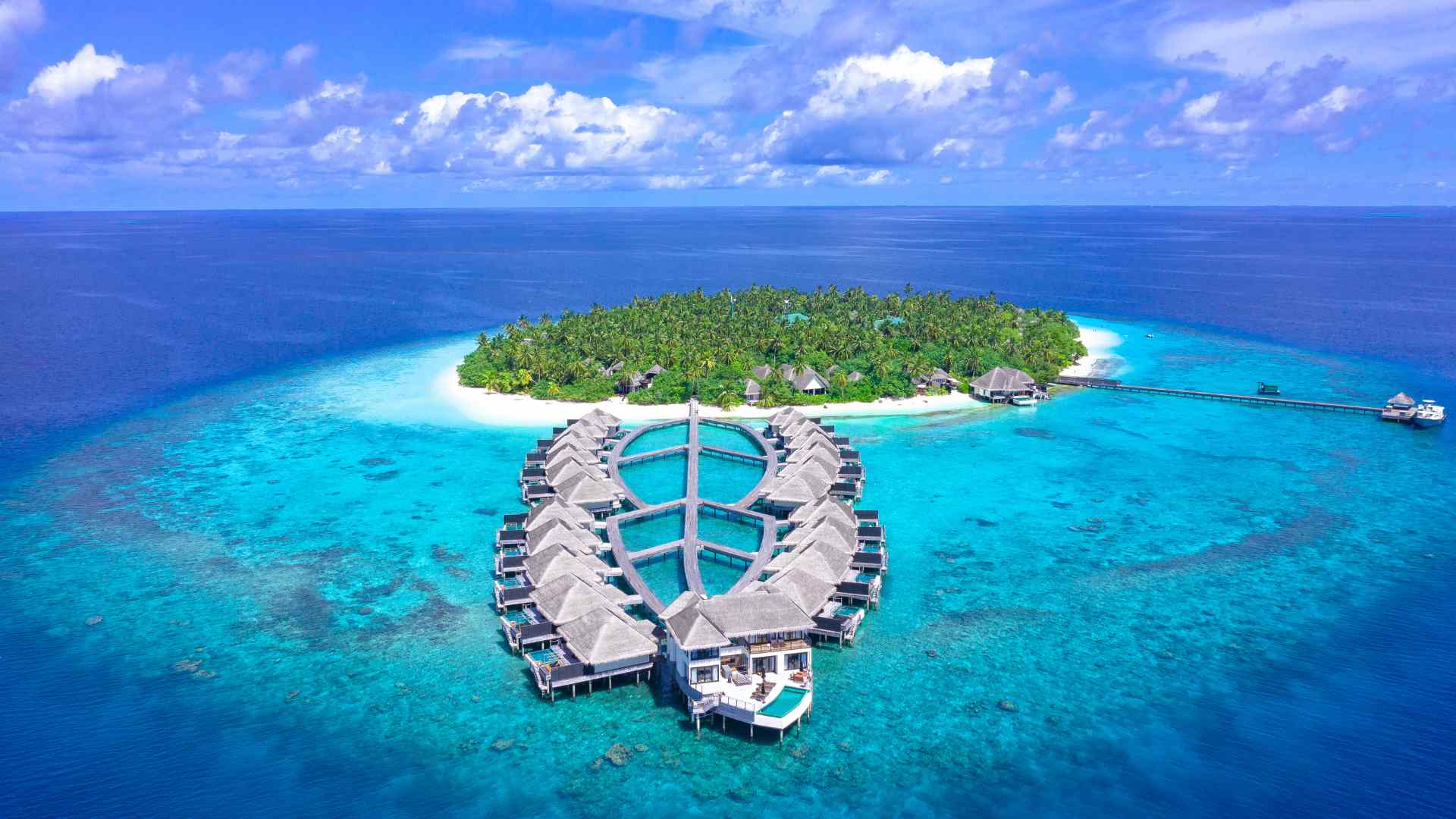
Here is the trick that makes the whole strategy work. A handful of resorts have no land based rooms at all, so their standard room is an overwater villa by default.
Those are the properties worth hunting for. Everything else is an uphill fight.
Belief: all certificates behave roughly the same
They behave very differently, and the differences are the whole game. Two programs can hand you a piece of paper called a free night and mean opposite things by it.
The important variable is whether the certificate is capped by a point value or by a hotel category. Capped by points means a fixed ceiling that dynamic pricing can float above.
Capped by category means the resort must fall within the award’s current category limit. Programs can recategorize hotels, so check again before you transfer points or plan flights.
Then there is topping off. Some IHG certificates allow added points, and Marriott currently permits points on top of eligible free night awards.
That does not guarantee an overwater category: confirm the actual standard-room availability.
Before you chase anything, check your own program’s current terms on all three points. These rules get revised more often than the marketing pages suggest, so read the terms rather than a summary of them.
Belief: if the resort is bookable with points, the certificate works too
This is the most expensive assumption on the list. Point redemptions and certificate redemptions are separate systems with separate inventory.
A property can be wide open for points and completely closed to certificates on the same date. You will not see an explanation, only an empty calendar.
Test it before you plan around it. Search the exact dates as a certificate booking, not a points booking, and see what the engine returns.
If the site is vague, call. Ask the agent specifically whether the water villa category is certificate eligible at that property, and ask them to say it twice.
Belief: a free night means a free night
Not on an island. The room is covered and almost nothing else is.
- Transfers: boats and seaplanes are charged per person and are never included in an award night.
- Green taxes and service charges: these are added by the destination and the property, not by the loyalty program.
- Meals: award stays usually do not carry a meal plan, and island food pricing is unforgiving.
- Upgrade fees: a cash upgrade from a beach villa to an overwater villa is quoted at the resort’s rate, not a discounted one.
A two-night certificate stay can cost more overall than a cheaper cash trip nearby once flights, transfers, and meals are added.
Price the whole thing before you celebrate. The real cost breakdown of an overwater trip is the number that matters, and the room is only part of it.
Belief: the cash upgrade path is a good backup plan
It is a plan. It is rarely a good one.
The logic sounds fine at first: use the certificate on the base villa, then pay the difference to move over the water. In practice the resort quotes that difference as a full nightly upgrade rate.
The reason is straightforward. The property never discounted the water villa in the first place, so there is no gap for your certificate to close.
You end up paying most of the overwater price anyway and burning a certificate for the privilege. That is a bad trade on both sides.
There is one exception worth knowing. Occasionally an upgrade is offered at check in at a fraction of the published rate, especially in shoulder season when half the jetty is empty.
Do not build a honeymoon around that possibility. Build it around a villa you already hold.

Belief: expiration dates are flexible
They are not, and this is where most certificates die. People earn one, wait for the perfect trip, and let it lapse in a browser tab.
Certificate expiry varies by issuer and award type. Check your certificate’s actual expiration and cancellation terms before building an itinerary around it.
For a stay longer than one night, check how many certificates you actually hold and whether each night has eligible standard-room award space.
My rule is to book the certificate stay first and adjust the rest of the trip around it. Award inventory disappears in a way that flights and transfers do not.
Belief: the Maldives is the only place this works
The Maldives has the deepest bench of branded overwater inventory, so it gets all the attention. It is not the only board.
French Polynesia has real chain presence, and certificate eligibility there is worth checking directly with each property. Villa categories are named inconsistently across brands, which works in your favor sometimes.
Fiji has a small number of branded water bures, and they move fast when they open. Set an alert rather than checking casually.
The Caribbean and Mexico have overwater villas at properties that mostly sit outside the big loyalty programs. That is worth knowing before you spend two years earning toward them.
If your points are stuck in one program, start with my guide to booking overwater bungalows with points and miles. It will tell you fast whether your balance is in a useful currency.
Belief: you should save the certificate for the fanciest resort you can find
I understand the instinct and I think it is wrong. The best certificate redemption is the one you can actually make, on dates you can actually travel.
Chasing the flagship property means competing with everyone else doing the same math. Availability at a famous resort may be limited; do not build a trip around a room you cannot confirm.
Compare less famous participating properties as well, but only count a water villa when the award engine actually confirms that category.
I would rather have four nights at a good resort than one night at a great one. One night on a remote island is mostly transfers anyway.
How I would actually work the search
- Start with the room list, not the resort. Find properties whose lowest category sits over the water.
- Search a wide date range first. Certificate inventory clusters in specific weeks, and you want to see the pattern before you pick.
- Check the day the calendar opens. Most programs load inventory a fixed number of months ahead, and that morning is your best odds.
- Book anything workable and refine later. Award bookings can usually be canceled, so hold the date while you think.
- Stack certificates with paid nights. A mixed reservation gets you a longer stay without the all or nothing gamble.
Also check shoulder season honestly. Award space opens when cash demand drops, and my overwater weather calendar will tell you what you are trading for it.
And if none of it lines up, stop forcing it. The affordable overwater options often beat a certificate stay you had to contort your calendar around.
Who should skip this strategy entirely
Skip it if you have one certificate and one fixed week. The odds of those two lining up at a qualifying resort are poor, and the search will cost you more evenings than it returns.
Skip it if your points sit in a program with no overwater properties at all. No amount of patience fixes an empty map.
And skip it if the certificate is steering you toward a resort you would never otherwise pick. A free night at the wrong place is the most expensive kind there is.
Belief: once you are over the water, the villa is the villa
Room assignment depends on property policy and the category you booked. Treat the confirmed room type as your entitlement, rather than guessing the upgrade order.
A certificate confirms a room category, not a specific jetty position or view unless the reservation says so. Ask the resort what can be requested within your booked category.
You still have leverage, and it costs nothing to use it. Email the resort two weeks out, mention the occasion if there is one, and ask politely for a villa toward the far end.
Be specific about what you want, because vague requests get vague results. Deep water, privacy, and afternoon shade are three different asks.
My breakdown of how to pick a position on the jetty is the right prep for that email. It takes ten minutes and it changes the whole stay.

Fast answers
Can I use two certificates for two nights in a row?
Usually yes, as long as the villa shows as available on both nights as a certificate booking rather than a points one. Add them to the same reservation so the property does not move you to a different villa halfway through the stay.
Do certificate stays earn status credit?
Night credit toward status is common, but earning points on a room rate you did not pay generally is not. Check your program’s current terms before you count the stay toward anything, because this is one of the rules that gets quietly revised.
Will elite status get me upgraded to overwater on an award night?
It happens, and it is not something to plan around, because resorts protect their highest revenue villas hardest. Treat any complimentary move over the water as a welcome surprise, not part of the value calculation.
Are certificate bookings refundable?
Often yes up to a cutoff date, and the certificate returns to your account when it is. Confirm whether it comes back with its original expiration attached, because a certificate returned three weeks before it lapses is barely a certificate at all.
Is it worth opening a card just for this?
Only if you have already found a specific property where that program’s certificate reaches a villa over the water. Earning first and searching afterward is exactly how people end up with expired paper and a story about the one they almost booked.
What I’d book
I would pick a resort whose entry level room is already over the water, then work backward to whichever certificate that program issues. That one filter removes most of the disappointment.
I would treat the certificate as a discount on a trip I was taking anyway, not as the reason for the trip. That keeps the transfers and the food from ambushing the budget.
And I would use it this year. A certificate you spent is worth infinitely more than a certificate you admired.
Certificate rules, caps, and which villa counts as a standard room get rewritten by both the programs and the properties. Confirm eligibility for your exact resort and dates with the program and the resort before you plan a trip around it.