Overwater Stays for Big Groups of Friends
Six friends, one group chat, and somebody has already sent a photo of a water villa at sunset.
Here is how to give everyone space, handle uneven budgets, and keep the trip fun.
Overwater stays for groups of friends: the honest answer
Overwater stays for groups of friends work beautifully when everyone has their own villa and terribly when you try to squeeze people together. Water villas are built for two, so the group version of this trip is many small rooms, not one big one.
That single fact drives the budget, the destination, and whether anyone is still speaking on day five. Below are the group types I keep running into, and my call on each.
The four-couple group that wants to be together
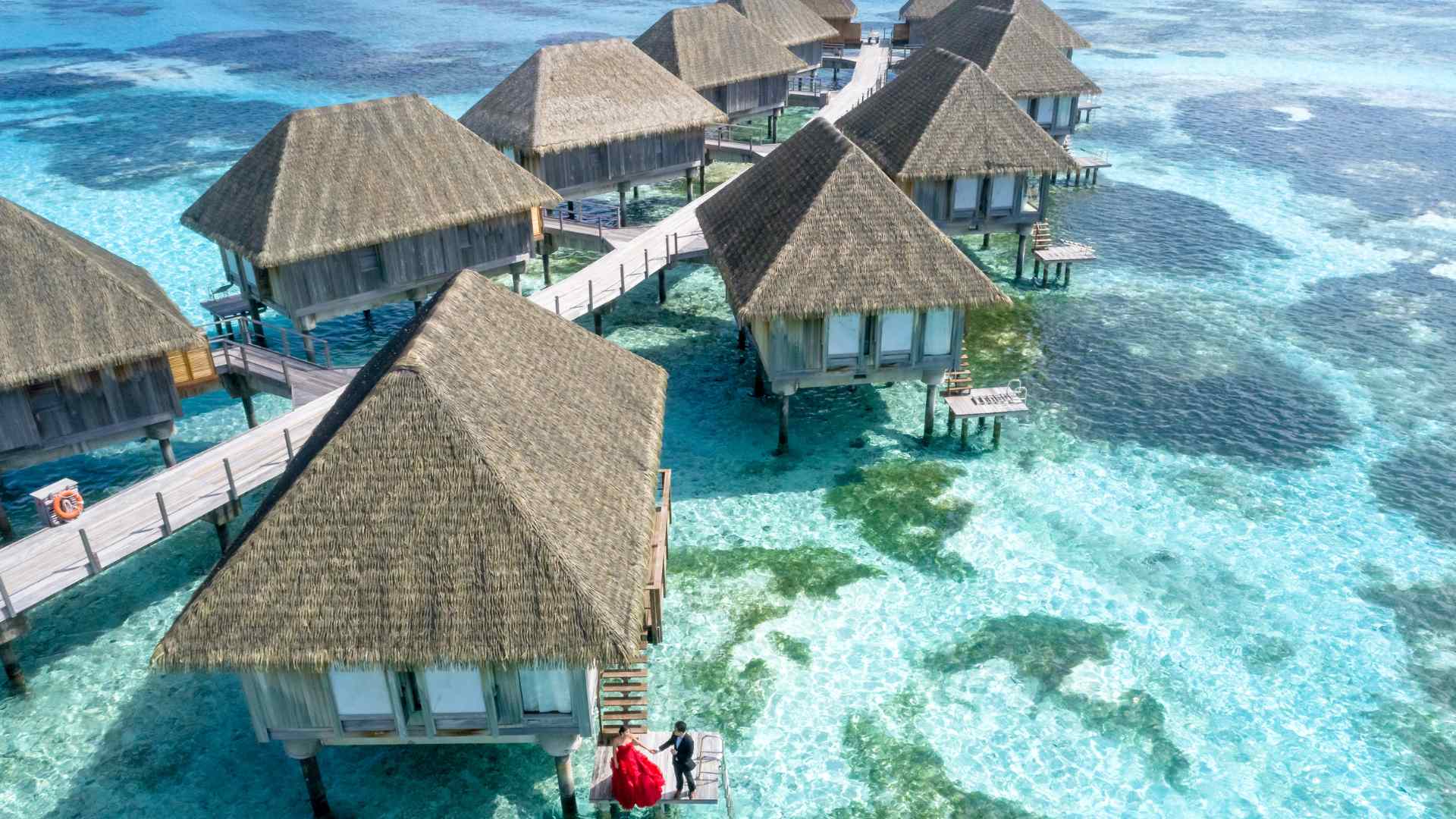
Travel Belize’s Thatch Caye listing describes a mix of overwater bungalows and oceanfront cabanas. A mixed room plan can keep a group together without forcing every friend into the same nightly price.
Travel Belize’s Thatch Caye listing describes a mix of overwater bungalows and oceanfront cabanas. A mixed room plan can keep a group together without forcing every friend into the same nightly price.
This is the easiest version and people still get it wrong. They book four villas at whatever the cheapest rate was, and end up scattered across two jetties on opposite sides of an island.
Book together, in one email, and say the word “group” out loud. Reservations teams can block adjacent villa numbers for you if they know before the rooms are assigned, which usually happens days ahead rather than at check-in.
Then ask for the far end of a single jetty. The end villas have the most privacy from the island side, and when your four are the last four you effectively get a private cul-de-sac over the lagoon.
Verdict: book it, but treat villa adjacency as a hard requirement rather than a nice-to-have.
The bachelorette, milestone birthday, or reunion group
Here the group wants noise, a shared table, and a base that is not somebody’s bedroom. A jetty full of two-person villas gives you nowhere to be together after dinner.
The fix is one shared space in the mix. Book a single beach villa or two-bedroom residence with a pool as the group living room, and put the rest of the party in water villas nearby.
The other thing to sort out before you arrive is noise policy. Plenty of resorts ask for quiet on the jetties after a certain hour, and a group that did not know that is a group having an awkward conversation with a manager.
Verdict: book it at a smaller, livelier property rather than a hushed luxury island where you will feel like you are being tolerated.
The mixed-budget group where one couple cannot stretch
This is the scenario that kills more group trips than any other, and nobody wants to name it in the chat. One or two people are quietly doing math they are embarrassed about.
Do not solve it by putting them in a cheaper room at the same resort and pretending that is equal. Resorts with a big gap between the entry room and the water villa create a visible class system inside your own friend group.
Solve it by picking a property where the water villa itself is the entry-level room. Those exist; compare the choices worth the flight in my guide to overwater bungalows that do not require a second mortgage.
The other lever is nights. Four nights where everyone is in the same category beats seven nights where two of you are in a garden room feeling weird about it.
Verdict: shorten the trip before you split the room categories. Always.
The group that wants to actually be on the water all day
If your friends dive, snorkel, or want to be in a boat by 8am, the resort’s water sports operation matters far more than the villa. A group of six is exactly the size that can fill a dive boat or a private sandbank drop-off.
Ask two things before booking. Whether the dive center runs private group charters, and whether the house reef is swimmable straight off the jetty or requires a boat every single time.
That second answer changes your whole week. My piece on how to judge a resort house reef before you book walks through the questions that get you a real answer instead of a brochure line.
Verdict: book the property with the better reef and the weaker room, not the other way around. Your group will spend six hours a day in the water and eight asleep.
The group that is secretly two groups
Half of you want to be horizontal for a week. The other half have already researched a hike, a fishing charter, and a place that does good grilled fish on the main island.
A one-island Maldivian resort punishes this split badly, because there is nowhere else to go and no way to opt out of the group without hiding. French Polynesia handles it far better since the resorts sit off inhabited islands with roads, restaurants, and things to do.
Southeast Asia is the other good answer for a split group, for the same reason and at a lower nightly rate. The Southeast Asia overwater bungalow roundup is where I would start that search.
Verdict: pick a destination with an exit. Isolation is romantic for two and claustrophobic for six.
The group considering a small island buyout
Thatch Caye says its island hosts up to 30 guests, which gives you a useful sense of buyout scale. Compare total rooms, staff, boats, and meal-plan minimums before anyone commits to paying.
Thatch Caye says its island hosts up to 30 guests, which gives you a useful sense of buyout scale. Compare total rooms, staff, boats, and meal-plan minimums before anyone commits to paying.
Once you get past roughly eight or ten people, taking the whole property stops being absurd and starts being arithmetic. Small private-island resorts with a handful of overwater rooms will quote you a full buyout, and the per-person number is sometimes lower than you expect.
What you get is the run of the place, one kitchen cooking for your group alone, and no strangers on your jetty. What you give up is the polish and the choice of restaurants that a big resort provides.
Belize is a strong fit for a small-group buyout because some caye properties have only a handful of rooms. Somewhere like the overwater cabanas at Thatch Caye gives you the shape of what that looks like.
Verdict: worth a quote request. Buyout minimums, night minimums, and what is included all move around, so ask rather than assume.
The money conversations nobody has early enough
If full-island privacy matters, Royal Belize describes a whole-island rental option for Thatch Caye. Get the buyout quote in writing before asking friends to commit to dates.
If full-island privacy matters, Royal Belize describes a whole-island rental option for Thatch Caye. Get the buyout quote in writing before asking friends to commit to dates.
Group trips do not blow up over the room rate. They blow up over everything bolted onto it.
- Transfers are per person. A seaplane or speedboat seat is charged individually and round trip, so a group of eight pays eight times, and it is often the second biggest line on the bill.
- Meal plans are per person too. Half board covers breakfast and dinner, full board adds lunch, and the gap between them across eight people over six nights is significant.
- Service charge and local taxes get added at the end. The Maldives applies a nightly environmental levy per guest on top of tax and service, and the rates get revised, so ask for a full quote in writing.
- One bar tab or eight. Decide before you land, not on the last night at the desk.
- Cancellation windows are stricter for blocks of rooms. If somebody drops out, find out now what that costs.
Get a single itemized quote for the whole group and forward it to the chat. I break the categories down properly in the true cost of an overwater bungalow vacation.
An all-inclusive plan is worth a hard look for groups specifically, because it removes the running tally that makes people tense. The all-inclusive overwater options are not always the cheapest, but they are the calmest.
The downside, and who should skip this entirely
Here is the real limitation. Water villas are designed to isolate people, which is exactly the opposite of what a group trip needs.
Every one is a private little box at the end of a walkway, with no shared kitchen, no big living room, and often no space to seat more than four. You are paying a large premium for architecture that works against your reason for traveling.
Skip the overwater villas entirely if your group’s whole point is cooking together, staying up late in one room, or splitting a house. A private villa rental with a pool and a kitchen will give you a better week for less money, and nobody will miss the jetty by Wednesday.
I would also skip it for any group where two people are only coming because they feel obliged. That dynamic gets worse on a small island with no way to leave.
And check the adults-only question early if anyone is bringing children, since the answer changes which properties are even available to you. My comparison of adults-only versus family-friendly overwater resorts covers where that line falls.
Things people ask me about group overwater trips
How many people can sleep in one overwater bungalow?
Most water villas are built for two adults, with some accepting a third on a sofa bed or daybed for an extra charge. Two-bedroom overwater residences exist but are rare and priced well above two separate villas, so confirm occupancy limits before you plan your split.
Can we get villas next to each other?
Usually yes, if you ask at the time of booking and again about a week before arrival, since villa numbers are typically assigned shortly before check-in. Adjacency is almost never guaranteed in writing, so treat it as a strong request rather than a confirmed feature.
Do resorts give group discounts on overwater villas?
Sometimes, and it is far more likely in low season or on a longer stay than on a peak-week booking. Ask reservations for a group quote rather than booking eight rooms online, because the discount often arrives as an upgrade, a free transfer, or a meal plan instead of a lower rate.
What is the best destination for a big group of friends?
French Polynesia or Southeast Asia, because both put you near inhabited islands with restaurants and activities so the group can split up without drama. A single-island Maldivian resort is the most beautiful option and the least forgiving one for a group with different energy levels.
Should one person handle the whole booking?
One person should handle communication with the resort so villa requests and timing stay consistent, but everyone should hold their own reservation and pay their own deposit. Putting eight people’s money on one credit card turns a friend into a creditor, which is a terrible way to start a vacation.
What I would book
For six adults with roughly matched budgets, I would take five or six nights at a mid-tier property in French Polynesia, all in the same category of water villa, all at the end of one jetty. Then I would add one shared beach villa as the group’s living room and split its cost evenly.
For ten or more, I would stop looking at big resorts and start requesting buyout quotes from small island properties. The math changes at that size and so does the quality of the week.
What I would not do is stretch anyone. A group trip where one couple is anxious about money is not a good trip, no matter how good the photos look.
If you are still choosing a region, my complete overwater bungalow destination guide lays out what each one actually costs to reach.
Group policies, buyout minimums and transfer pricing shift from season to season, so get your numbers confirmed in writing by the resort before anyone pays a deposit.