Florida Underwater Hotels: The Real Jules Adventure and What It Is Not
Florida has exactly one place where an ordinary traveler can sleep in a submerged habitat, and it is nothing like a glass-domed Maldives villa. Jules’ Undersea Lab is a compact Key Largo aquanaut adventure reached through the lagoon, which makes the experience more science expedition than luxury escape.
Florida underwater hotels in 30 seconds
- What is real: Jules’ Undersea Lab offers an educational overnight aquanaut program in Key Largo.
- Best for: confident divers and curious travelers who value the story more than hotel polish.
- Biggest catch: it is an underwater habitat, not a conventional resort suite, and participation rules matter.
- My pick: the overnight for qualified adventure seekers, or the shorter Jules tour for anyone intrigued but not ready to sleep below the lagoon.
This is not a property I would force into an OTA booking link because ordinary hotel inventory does not describe the current program accurately. The official Jules page is the correct early stop for current dates, eligibility, inclusions, and the difference between a tour and an overnight.
The honest answer about Florida underwater hotels
Jules began as a research habitat and later became famous as an underwater hotel. MarineLab now operates it within a nonprofit educational park, where the overnight is framed as an Aquanaut Adventure rather than a luxury room with conventional check-in.
That wording is not a downgrade. It is the reason the experience remains interesting: guests enter a real submerged habitat, learn how undersea living works, and spend the night with round windows looking into the lagoon.

What the overnight actually involves
The program spans two days and one night, with preparation, in-water activity, habitat time, meals, and guided support described by MarineLab. Current certification, medical, equipment, and schedule details should come directly from the operator.
I would choose it for a celebration between divers, a parent-and-older-child science adventure when eligible, or anyone who finds life-support systems as fascinating as fish. I would not present it as a surprise romantic hotel because the gear and training are part of the point.
The room is deliberately practical
Inside, expect a compact habitat with sleeping space, life-support equipment, windows, and the practical feel of an undersea lab. The charm comes from knowing the water is outside and access is through it, not from marble, a spa bath, or a butler polishing the porthole.
Space is shared, privacy is limited, and everything you bring must make sense in an unusual environment. Travelers who love clever systems may be delighted; travelers who need a king bed and blackout curtains should remain above sea level.
The shorter Jules tour may be the smarter choice
MarineLab also publishes a shorter guided experience inside Jules. It gives curious visitors a chance to see the habitat and learn its story without committing to the overnight program.
I would start here if anyone in the party is uncertain about confined spaces or underwater access. A few memorable hours can be more enjoyable than an ambitious night spent wondering when morning officially begins.

What is not an underwater hotel
Aquarius Reef Base
Aquarius is a working undersea research laboratory, not an ordinary vacation hotel. It appears in Florida search results because it is famous and genuinely submerged, but travelers cannot browse dates and reserve it like a resort suite.
EPCOT DiveQuest
Disney’s DiveQuest is a scuba experience inside The Seas aquarium. It can be great fun for certified divers, yet nobody sleeps in a hotel room behind the glass.
Discovery Cove SeaVenture
Discovery Cove’s SeaVenture is a helmet-based underwater walking experience with medical and participation requirements. It belongs on a Florida underwater-activities list, not an accommodation list.

Jules versus a luxury underwater suite
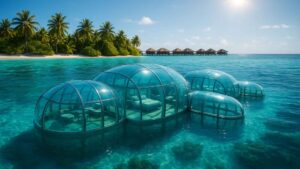
Atlantis Dubai and Maldives properties use giant viewing windows, polished service, and conventional dry access. Jules asks you to participate in reaching and understanding the habitat, so its strongest luxury is bragging rights with excellent scientific backstory.
Our world underwater hotel guide compares those categories, while the Dubai underwater guide covers an easier aquarium-facing suite. Neither is a fair direct substitute for the Key Largo adventure.
Who should book Jules
- Divers who enjoy unusual environments and are happy following a structured program.
- Science-minded families or friends who meet the current age, medical, and skills requirements.
- Travelers who value a rare story more than conventional hotel comfort.
- People comfortable with shared compact space, underwater entry, and a deliberately hands-on experience.
Who should choose something else
Skip the overnight if confined spaces, scuba access, medical restrictions, or shared compact rooms create anxiety. A shorter tour, aquarium dive, or excellent waterfront Key Largo hotel will produce a far happier trip.
Our Florida overwater guide explains the state’s water-adjacent stays, while the United States overwater guide broadens the search without pretending a cottage beside water is an underwater bedroom.
How I would plan the Key Largo trip
I would place Jules in the middle of a Keys stay rather than on arrival night. That creates time for weather changes, program preparation, and a normal bed before or after the adventure.
A second day for snorkeling, paddling, or reef activities keeps the trip connected to the marine setting. It also means the entire vacation does not depend on one program running exactly as expected.
What arrival and entry feel like
A normal hotel starts with a lobby and key card; Jules starts with preparation for entering the lagoon. That change of sequence is why the program feels like an expedition before anyone has even discussed where the toothbrush belongs.
The operator controls the actual training and entry process, so old videos should not be treated as instructions. I would arrive rested, fed, and ready to follow the current team rather than trying to prove that an internet tutorial covered everything.
Comfort matters, even on an adventure
Ask about temperature, bedding, humidity, lighting, toilet arrangements, personal storage, and noise from life-support equipment. None of those questions makes the experience less daring; they simply help everyone picture the night accurately.
I would bring the smallest approved set of personal items and leave sentimental electronics on dry land unless the operator says otherwise. Underwater habitats reward tidy packing with the enthusiasm of a very small boat cabin.
Weather and visibility are not customer settings
Key Largo’s lagoon conditions respond to rain, wind, temperature, and natural water movement. The round windows may show fish and green-blue light, but the view can be quieter or murkier than the sharpest promotional photograph.
That does not remove the main thrill, which is inhabiting the space itself. Anyone booking only for a guaranteed parade of marine life should choose a managed aquarium experience instead.
Build a graceful backup plan
A weather-sensitive underwater program deserves a surrounding itinerary that can bend. I would reserve a flexible shore hotel, avoid a nonrefundable flight immediately after the scheduled exit, and learn the operator’s cancellation terms before arrival.
The backup day does not have to feel wasted. Key Largo offers marine education, paddling, snorkeling, diving, and waterfront restaurants, so the destination can still work when one activity changes.
Why the educational framing is a strength
MarineLab connects Jules with undersea science and the history of human habitation below the surface. That context turns the night from a novelty into a chance to understand pressure, support systems, communication, and the practical challenges researchers face.
I would lean into that side of the trip. The most interesting souvenir is not proof that you slept underwater; it is a clearer sense of how much work makes an apparently quiet room possible.
What to confirm before booking
- Current certification, age, swimming, medical, and equipment requirements for every participant.
- The exact program schedule, included meals, gear, training, and cancellation rules.
- Weather policies and what happens if water conditions interrupt access.
- Sleeping setup, privacy, bathroom arrangements, and what personal items may enter the habitat.
The claustrophobia question deserves honesty
Jules has windows and life-support systems, but it remains a contained habitat beneath the lagoon. I would watch current operator video and choose the tour first if enclosed spaces have ever caused panic.
There is no prize for enduring a night you dislike. The most confident person should not volunteer everyone else for an underwater sleep simply because the story will sound impressive later.
Frequently asked questions
Is Jules still an underwater hotel?
Jules is currently operated by MarineLab as an educational underwater habitat offering tours and an overnight Aquanaut Adventure. Calling it a conventional hotel misses the structured, skills-based nature of the current experience.
Do you have to scuba dive to reach Jules?
The habitat is entered underwater, and the overnight program has current skills and training requirements published by MarineLab. Confirm the exact pathway for your experience directly with the operator.
Can non-divers visit?
MarineLab publishes different programs and may provide training pathways, but eligibility varies. The official program page should be treated as the deciding source for certification, swimming, age, and medical rules.
Are there luxury underwater suites elsewhere in Florida?
No operating Florida hotel currently offers a dry-access luxury bedroom with panoramic underwater windows like Atlantis or The Muraka. Florida’s real overnight is the adventure-focused Jules habitat.
Can children stay overnight?
Participation depends on the current program’s age, skills, supervision, and medical rules. Families should obtain written eligibility confirmation for each child before making surrounding travel plans.
My final take
Jules is wonderfully specific: a real underwater habitat for travelers who want to participate, learn, and earn the story. It should be recommended on those terms, not dressed up as a Florida version of a Maldives residence.
I would book the night for a confident aquanaut and the shorter tour for everyone else. Both honor what makes Jules special without asking it to become a hotel it no longer claims to be.
Most importantly, everyone should choose the same level of adventure freely. A willing group will laugh about the tight quarters and unusual routine, while a reluctant guest may spend the night counting every mechanical sound until breakfast.
How I researched this Florida guide
I used MarineLab’s current program pages to distinguish the overnight, tour, and educational mission, then checked official attraction pages for the Florida experiences commonly mislabeled as hotels. I excluded research-only facilities, fixed prices, and any participation promise not supported by the current operator.