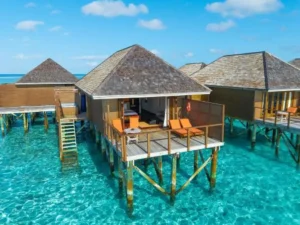
Is a Second Row Overwater Villa Worth It, or a Trap?
Second row overwater villas are the cheapest way into a water villa trip, and resorts know exactly why you are tempted.
Some are a genuine bargain. Some are a room with a view of somebody else’s roof.
Here are the room details that distinguish the two rows.
The short answer before the details
A second row overwater villa is worth it when the two rows are staggered, the water under your ladder is deep enough to swim at low tide, and the saving buys you extra nights. It is a trap when the inner villa is physically smaller, faces the back wall of the villa in front, and the discount is thin.
- Book it if: the jetty is staggered, you came for the reef more than the deck, or the saving adds nights to the trip.
- Skip it if: an open horizon is the exact picture in your head and this is a once in a decade trip.
- Always ask: the square footage of both categories, the low tide depth under the ladder, and which villa numbers face west.
- Never assume: that a category name tells you which physical row you are actually booking.
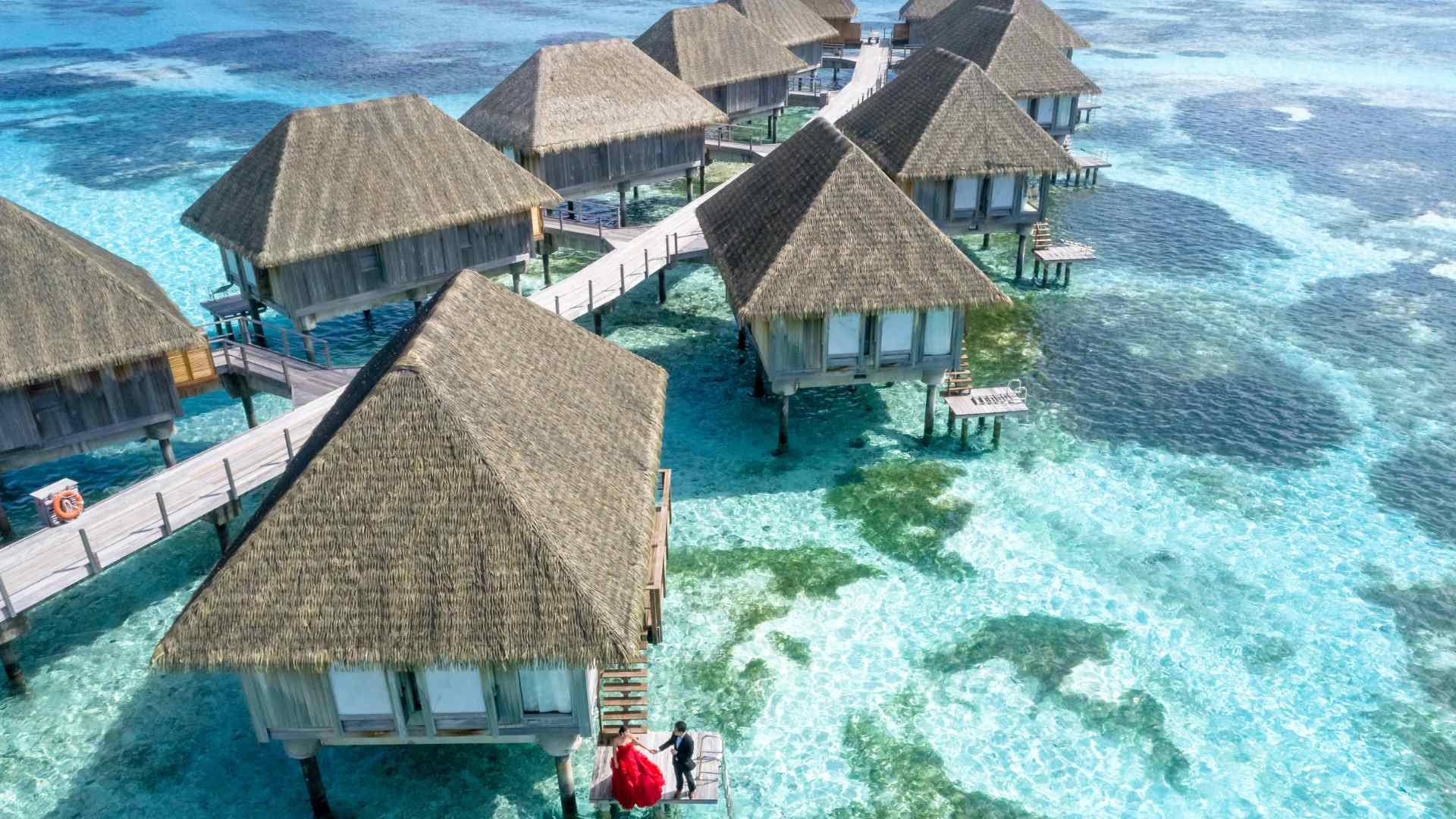
“It’s the same villa, just cheaper”
Sometimes it is. At plenty of resorts the inner row and the outer row are the identical building, dropped on the identical stilts, with the identical bed and the identical deck.
But at plenty of others, the cheaper category is also the smaller one. The floor plan shrinks, the deck loses a few feet, and the outdoor shower quietly disappears.
You cannot tell from the price alone. Ask the resort directly whether the two categories share a floor plan, and ask for the square footage of each one in writing.
If the answer comes back vague, treat that as an answer. Nobody is coy about a villa that measures well.
“The view is basically the same water”
This is the myth that costs people the most happiness. The water may be the same water, but you are not looking at it the same way.
From the outer row you look at horizon. From the inner row you often look at the back of the villa in front of you, with a strip of lagoon on either side of it.
That strip can still be beautiful. It is just a different product, and it should be priced like one.
The variable that matters is offset. If the inner villas are staggered so each one looks through a gap rather than at a wall, the second row can be almost as open as the first.
Pull up a satellite view of the jetty before you book. You will learn more in two minutes of looking at the layout from above than in an hour of reading the room description.
I go into the geometry in more detail in my guide to choosing a villa position on the jetty, because position beats category more often than people expect.
“I can still just climb down my ladder and swim”
Check this one. Not every second row villa has a ladder, and not every ladder leads anywhere you want to be.
Inner rows sit closer to shore, which usually means shallower water. Shallower water at low tide can mean you are standing on sand, or worse, standing on coral rubble you should not be standing on at all.
Some resorts solve this beautifully and the inner lagoon is a soft sandy wade. Others hand you a ladder that ends six inches above the bottom at 2 p.m.
The mechanism is simple once you see it. The lagoon floor ramps up toward the island, so the closer your stilts sit to the beach, the more of the tide swing you feel underfoot.
The question to email is simple. At low tide, how deep is the water under this specific villa category, and can I swim from the ladder at all times of day?
If swimming from your own deck is the whole reason you booked overwater, this is the deciding question, not the view. I unpack that tradeoff further in private pool versus direct lagoon access.
“The price gap tells you how much worse it is”
It does not. The price gap tells you what the resort thinks it can charge, which is a different thing entirely.
At a property with a huge, wide lagoon, the second row can be a small discount for a genuinely small compromise. At a property with a cramped jetty, the discount can be large and still not large enough.
A small discount can be worthwhile when both rows share the same room and access. A large price gap deserves a closer look at the actual floor plans and sightlines.
Judge the villa, then look at the price. Doing it in the other order is how people talk themselves into a room they resent by day three.
“Second row means less privacy”
Often true, occasionally backwards. It depends entirely on which direction the decks face.
If the inner row faces the backs of the outer villas, you get less privacy and so do they. If the two rows face away from each other, the inner row can be the quieter side of the jetty.
There is also foot traffic. Inner villas sit nearer the walkway back to the island, so more people pass your door on the way to dinner.
That matters more than most people plan for. A villa you cannot lounge on in a swimsuit is a deck you will use half as much.

“You’ll barely be in the room anyway”
This is the line travel forums repeat, and on a city trip it is true. On an island where the resort is the destination, it is nonsense.
You will be in that villa a lot. Mornings on the deck, the flat hot hours after lunch, and the long slow evening when there is nowhere else to go.
The whole reason overwater costs what it costs is that the room is the activity. Buying the cheapest version of the activity is a real decision, not a technicality.
That said, a room you can afford for six nights beats a better room you can only afford for three. Compare a longer stay in the less expensive row with a shorter stay at the front before deciding.
“Sunrise and sunset don’t factor into it”
They factor into it more than the row does. A second row villa facing the sunset can be a better room than a first row villa facing a blank sky.
Direction is free. Nobody charges extra for east or west at most resorts, so it is the one upgrade you can request without paying for it.
Decide which one you actually want first. My take on that is in sunrise versus sunset water villas, and it is not the obvious answer.
When a second row overwater villa is worth it
There are four situations where I stop hesitating.
- The rows are staggered. If your sightline runs through a gap instead of into a wall, you are getting most of the view for less money.
- The discount buys nights. Two extra nights in the inner row will do more for your trip than a horizon you look at for the same total hours.
- You booked for the reef, not the room. If you plan to be in the water or off on boats all day, the deck view is the least important thing you are paying for.
- The outer row is the loud side. At some resorts the ocean-facing villas take the wind and the wave noise, and light sleepers do better inside.
And one situation where I would not. If this is a once-in-a-decade trip and the horizon is the picture in your head, do not buy the compromise version of your own daydream.
I would also skip the inner row on a very short stay. On three nights you do not have time to make peace with a view you did not want.
How to check before you pay
Email the reservations team, not the booking site. You want answers from someone who can see the map.
- Is the inner row the same floor plan and the same square footage as the outer row?
- Are the rows staggered or directly aligned?
- What do I see from the deck of a typical inner villa?
- How deep is the water under the villa at low tide?
- Which villa numbers in this category face west?
- Can you send a photo taken from the deck this year?
That last one does the heavy lifting. Marketing photos are shot from the best villa on the property, usually at the best hour, usually years ago.
If nobody can produce a current photo from the category you are actually booking, that tells you something. It does not always mean no, but it means ask again.
Rates, villa counts, and category names get reshuffled between seasons, so treat anything you read months ahead as provisional. Confirm the current layout and pricing with the resort itself rather than trusting a cached room description.

“A trap is a trap at every resort”
The second row is a completely different proposition depending on where you are standing. That is the part most advice skips.
On a long, thin jetty pushed far out into a wide lagoon, the inner villas are still a long way from shore and still surrounded by open water. The compromise is mild.
On a short jetty hugging the island, the inner villas can be close enough to hear the beach bar. That is not the trip you were picturing.
So the honest answer is that there is no universal verdict on second row villas. There is only a verdict on the specific jetty you are about to pay for.
Some destinations lean one way as a rule. Big atoll lagoons tend to be forgiving, and my Maldives water villa guide covers which layouts hold up best.
Things people ask me about second row villas
Do resorts upgrade second row bookings often?
Sometimes, but never reliably enough to book on. An upgrade depends on how empty the outer row happens to be the morning you land, so book the villa you would be content to spend the whole week in and treat anything better as a gift you ask for politely at check-in.
Is a lagoon view villa the same as a second row villa?
Not necessarily, because category names are marketing rather than geography. At one resort a lagoon view villa sits in the inner row of the jetty, at the next it is a beach room facing the water, so ask which physical row the name refers to at that specific property.
Will I still get the glass floor or the net?
Only if the category description says so in writing. Glass panels, hammock nets, and outdoor showers are usually the first features trimmed from the entry tier, and booking agents quote the flagship villa by mistake often enough that you should ask for the inclusion list.
Does the second row get worse service?
No, and I would be suspicious of any resort where it did. Service levels track the suite and residence categories rather than the row, so the housekeeping schedule and the host you are assigned should look identical whether your villa sits inside or outside.
Is it worth paying to switch rows mid-stay?
Rarely, because moving rooms eats an afternoon you paid a great deal for. The walk-up price to switch is almost always worse than the rate you could have locked in at booking, and you spend the best light of the day repacking a suitcase.
How much cheaper is the second row usually?
It varies far too much by resort and season for a number to be useful, and anyone who quotes you a fixed percentage is guessing. Ask for both categories on your exact dates in one email so you are comparing the same week rather than two cached rate sheets.
Where I’d spend the money instead
If the gap between rows is small, pay it and stop thinking about it. If the gap is large, take the second row and put the difference into nights, transfers, or a meal plan that stops you flinching at dinner.
The second row is not a trap. It is a trap only when you buy it expecting the first row and find out on arrival day.
Run the numbers honestly before you commit, and my breakdown of the true cost of an overwater trip will show you where that saving actually goes. If the whole rate sheet is out of reach, the answer is a different resort, not a worse room, and I keep a running list of affordable overwater bungalows for exactly that.
Picture the view from the deck when you would actually use it, including the early morning. Choose the row that gives you the privacy and outlook you want.
Compare actual layouts such as Hilton Amingiri’s villas, Soneva Jani’s floor plan, and the Westin’s room gallery. Ask for a map and a photo of the precise category before deciding whether a second row discount is worthwhile.
Villa categories, jetty layouts, and rate sheets get reshuffled more often than resorts announce. Check the details of your row and travel dates directly with the property before paying a deposit.