
Hurricane Season Rebooking Rights: What Resorts Actually Owe You
A storm near your overwater resort can disrupt the villa, the flight, and the transfer in different ways. Check each reservation before you pay, so you know exactly which part of the trip you can move or recover.
Here is what resorts actually owe you in hurricane season, and what they only owe you sometimes.
Hurricane season rebooking rights in 30 seconds
Resort cancellation and storm policies differ, and consumer protections can depend on where and how you booked. Many resort guarantees offer a date change or credit with conditions, so read the written policy before treating it as a cash refund.
- Check the trigger: the reservation may require a closure, evacuation, or disrupted access, and the precise wording matters.
- A guarantee is a date move: usually inside a set window, and often with a rate difference to pay.
- Know your booking channel: contact the resort or the agency named on your confirmation for a room change.
- Buy coverage early: a newly purchased policy typically excludes claims tied to a storm already named.
- Ask early and ask for a move: a move costs the resort less, so it gets approved more.
- Walk away from: a small storm season discount attached to a nonrefundable deposit.
“A named storm means I get my money back”
It does not. A named storm is a weather event, not a contract clause.
The reservation terms set out when the resort offers a change or refund. Ask whether closure, evacuation, or loss of access qualifies, and how much notice and documentation the resort requires.
A storm that passes offshore may leave the resort open even if the beach weather is poor. In that case, a change of mind may fall under the ordinary cancellation terms.
I am not being cynical here. I am telling you the standard the resort will apply when you call, because that is the standard its reservations team is trained on.
“A hurricane guarantee is a refund”
A resort storm guarantee may offer a date change, a credit, or a refund. Read its exact terms; a rebooking promise is not automatically a cash refund.
A rebooking right means you get to come back later, often within a set window, often in the same season, often with a rate difference you have to pay if the new dates cost more. It is a credit with strings, not cash returning to your card.
That rate difference is the clause people miss. You are rebooking at whatever the property charges on your new dates, so moving from a cheap September week to a February one can cost you more than the storm did.
Read the window carefully before you assume it is generous. If the guarantee sends you back within a year and you can only travel in one specific month, you may be rebooking into the exact same storm season you just fled.
Also check whether the credit covers just the room or the whole package. Meal plans, transfers, and prepaid excursions often sit under different rules, and the transfer is frequently the piece that is hardest to recover.
“The resort makes the call, so I only need to deal with the resort”
Only if you booked with the resort directly. Whoever holds your money holds the decision.
If you booked through an online travel agency, the resort can be perfectly willing to move you and still tell you it cannot process anything. The agency owns the reservation record, and the resort will not touch it.
If you booked a package with air included, you now have a third party in the chain, and the flight and the room may have completely different storm policies. That is the scenario where people lose the most money.
This is the single biggest argument for booking storm season trips direct, or through an advisor who will fight the phone queue for you. In good weather the channel barely matters, and in bad weather it is the whole game.
“Travel insurance covers hurricanes”
Some policies do, under specific conditions, and only if you bought the policy before the storm existed. That last part is where most claims die.
A policy bought after a storm is named typically will not cover losses caused by that storm. Insurance commissioners advise checking coverage while the event is still unforeseen.
Standard trip cancellation coverage also tends to require an actual triggering condition, not a bad forecast. Common triggers include your resort being rendered uninhabitable, a mandatory evacuation, or a carrier canceling your flight outright.
If you want flexibility beyond covered reasons, compare cancel-for-any-reason coverage and its purchase deadline. It usually reimburses only part of the insured cost, and eligibility varies by policy and state.
I think it is worth pricing for an expensive overwater trip in an exposed month, and skippable the rest of the year. That is a real cost, so decide with the number in front of you rather than on principle.
Check your credit card benefits before you buy anything separate. Some premium cards carry trip protection when you pay with the card, and the terms are worth ten minutes of reading.
“Hurricane season is a Caribbean problem”
It is the loudest one, because the Atlantic season is well defined and runs from the start of June through the end of November. But storm risk is not exclusive to one ocean.
The South Pacific has its own cyclone season on the opposite half of the calendar, which is why Fiji pricing looks so different in different months. If you are shopping Fiji overwater bungalows at a suspiciously good rate, look at the date before you look at the deal.
The Maldives does not get hurricanes in the way the Caribbean does, but it does get a wet monsoon period with wind, gray days, and rough transfer conditions. Different risk, same effect on your photos.
I keep an overwater bungalow weather calendar for exactly this reason. Cheap months are cheap for a reason, and the reason is almost always weather or school terms.
“If the resort stays open, I have no case”
You may have no contractual case and still have a good practical one. Those are different things, and people give up too early.
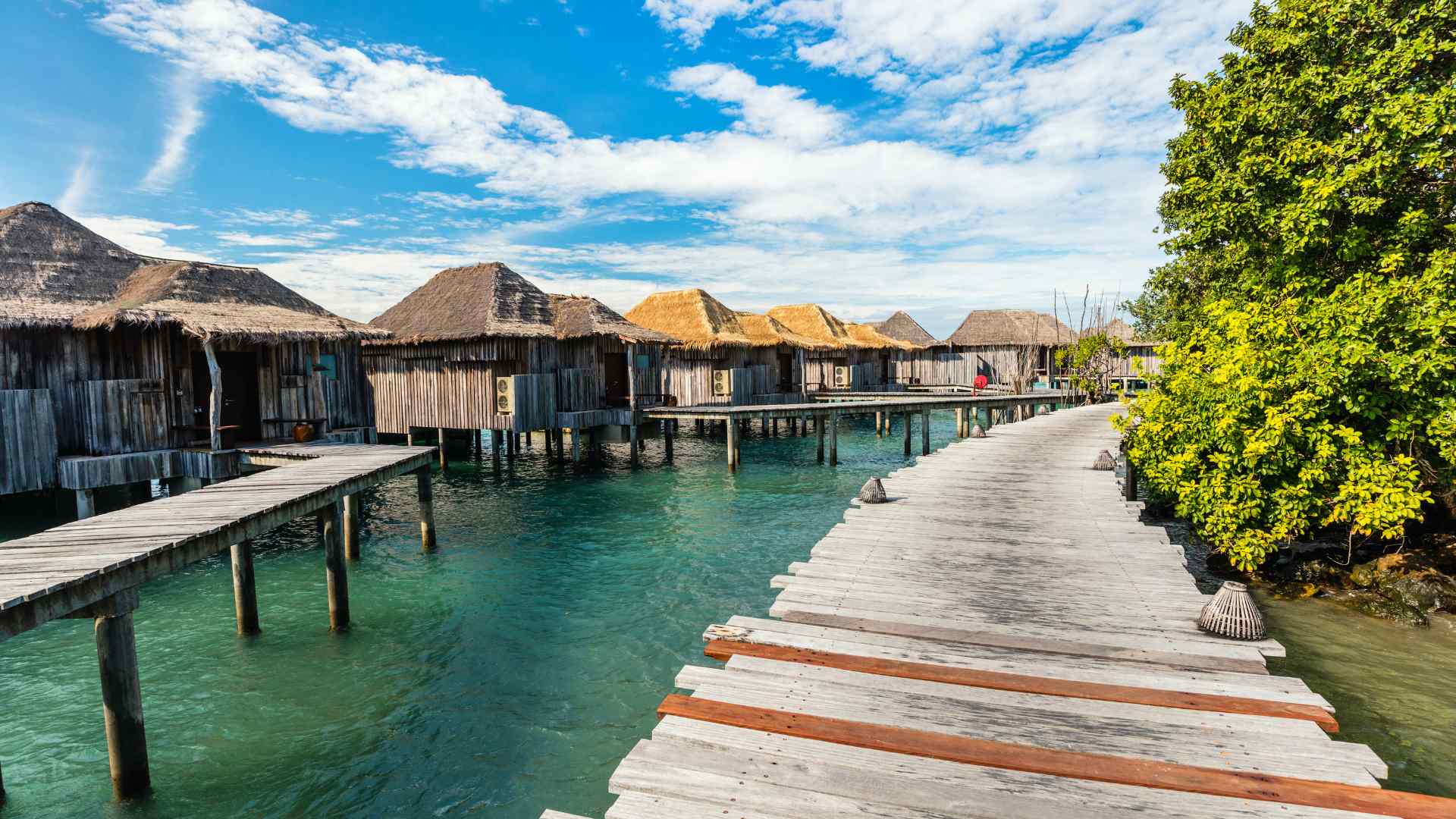
Overwater villas also have a failure mode a beach room does not. When the wind comes up the jetty gets closed, and a closed jetty means your dinner arrives cold or you are not leaving the villa at all.
That is worth naming on the phone, because it is concrete. A resort that cannot get you off your own boardwalk is not delivering the thing you bought, whatever the forecast technically says.
Resorts do not want a miserable guest posting storm photos from a closed overwater restaurant. Managers have discretion, and discretion gets used on guests who are calm, specific, and easy to say yes to.
If your rate or applicable law gives you a refund, request it. If only a date change or credit is available, ask for the option that protects the most of your payment.
Ask early, before the property is fielding a hundred calls an hour. Contact the property before departure when a serious forecast could affect your stay.
“I should wait and see what the storm does”
Waiting is how you end up with no options and no leverage. The flexible answers all live earlier in the timeline.
Airlines often issue travel waivers before a storm lands, and those waivers have a deadline. Miss it and your free change window closes while you are still refreshing the forecast.
Ask the resort about available replacement dates as soon as a disruption becomes likely, and keep a written record of the response.
Decide your personal trigger in advance and write it down. Mine is simple, and it is that if the forecast still points at the island 72 hours out, I move the trip rather than gamble on a lucky wobble.
“Booking in storm season is a mistake”
Not automatically. It is a mistake at full price with rigid terms, and a genuinely good trade at a discount with flexible terms.
The math I use is blunt. If the shoulder season rate saves you enough to fund a second trip later, and the cancellation window is generous, the risk starts looking reasonable.
If the discount is small and the deposit is nonrefundable from the day you book, walk away. You are absorbing the resort’s weather risk for a rounding error.
Skip storm season entirely if this is the only trip you get this year, or if it is a honeymoon with a fixed date. Anniversary weeks and one shot trips are the wrong things to gamble on a forecast.
Storm-season travel can still be worthwhile when your reservation, flights, and insurance leave room to change plans. Read the cancellation terms before paying for a nonrefundable overwater villa.
What actually protects you
Five things, in the order I would set them up.
- A written policy: get the storm terms in an email, not a phone summary.
- A direct booking: or an advisor whose name you know and who answers the phone.
- A late deposit deadline: money you have not paid is money you cannot lose.
- Insurance bought at booking: before any storm has a name.
- A pre-decided trigger: so you act on a rule, not on adrenaline.
None of that is exciting. All of it is the difference between a moved trip and a lost one.
If you are budgeting the whole thing, my breakdown of the true cost of an overwater bungalow vacation covers where the unrecoverable money usually sits. Transfers and prepaid extras are the usual culprits.
The questions that come up every time
Will a resort ever just refund me?
Possibly. If the resort cannot provide your paid stay, ask which refund or rebooking term applies and keep its response in writing.
Does a flight cancellation cancel my room?
An airline cancellation does not automatically cancel a separately booked room. For flights to, from, or within the United States, the US Department of Transportation explains when you can choose a refund instead of replacement travel; contact the resort separately about your room.
Is a hurricane guarantee worth choosing a resort over?
In an exposed month, yes, because it is one of the few marketing promises that turns into real money when things go wrong. Compare the guarantee windows side by side though, since one that only lets you return within a few months is barely a guarantee at all.
Should I just book somewhere without a storm season?
No tropical destination guarantees perfect weather, but storm seasons and their risks differ considerably by region. Compare Caribbean overwater options against water villas in the Maldives month by month rather than by reputation.
What if I paid with points?
Award stays are usually more flexible than cash rates, and many programs let you cancel and redeposit far closer to arrival. That flexibility is an underrated reason to use points in an exposed month, and my guide to booking overwater bungalows with points and miles covers how it works.
The short version
Read the room terms, the transfer policy, and any storm guarantee before you fall in love with the villa. The National Hurricane Center lists the Atlantic season as June 1 through November 30, but a calendar date alone does not establish your booking rights.
Compare direct and agent booking terms in storm months, buy insurance before a storm becomes a known event, and choose a deposit you can afford to have tied up. Put the cancellation deadline in your calendar.
The travelers who come out fine are not lucky. They are the ones who decided what they would do back when the ocean was calm.
Storm policies, guarantee windows, and insurance terms get rewritten between seasons. Confirm the exact wording that applies to your dates with the resort, in writing, before you pay a deposit.