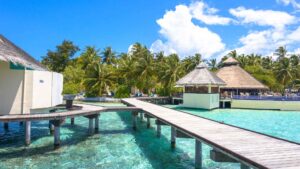
Overwater Resorts With the Best House Reefs
A house reef is the coral you can reach from the resort without a boat. It is the single most underrated thing you can book, and it is the thing most people find out about after they arrive.
Which overwater resorts have the best house reefs?
In the Maldives, the reef-first names I keep coming back to are Ellaidhoo, Angaga, Filitheyo, Kandolhu, Bandos, Embudu, Machchafushi, Taj Coral Reef and Nika. For a luxury version of the same idea, Six Senses Laamu, Vakkaru, Baros, Milaidhoo, W Maldives and Park Hyatt Hadahaa all sit on real coral rather than a bare sand lagoon.
Outside the Indian Ocean, the best reef under an overwater room is in Indonesia and Malaysian Borneo. Misool, Kri Eco Resort, Papua Explorers and Papua Paradise in Raja Ampat, and Sipadan-Kapalai, Mabul Water Bungalows, Lankayan and Pom Pom off Sabah.
That is the list. Now the reasoning, because the list on its own will lead you somewhere wrong.
What actually makes a house reef good?
Four things, and only one of them is coral. The rest is access.
The first is distance from your villa ladder to the reef edge. Anything under about a hundred feet means you swim there in a minute and you will actually go every day.
The second is depth over the reef flat at low tide. If the flat dries to ankle depth twice a day, your snorkeling window shrinks to half the daylight hours.
The third is current. A reef with a channel beside it is spectacular and it will also carry you away from the island faster than you can swim back.
The fourth is coral health, which is the one everybody talks about and the hardest to verify from a brochure photo. Ask for a picture taken this year, and if nobody can produce one, that tells you something.
Why can a gorgeous lagoon have limited reef snorkeling?
Because of how the islands were chosen and how the villas were built. Some long-established resorts have reef access close to shore, while others do not.
Many newer resorts favor broad sandy lagoons for the view and space around long jetties. Some construction changes the seabed, but a sandy lagoon can also be naturally sandy.
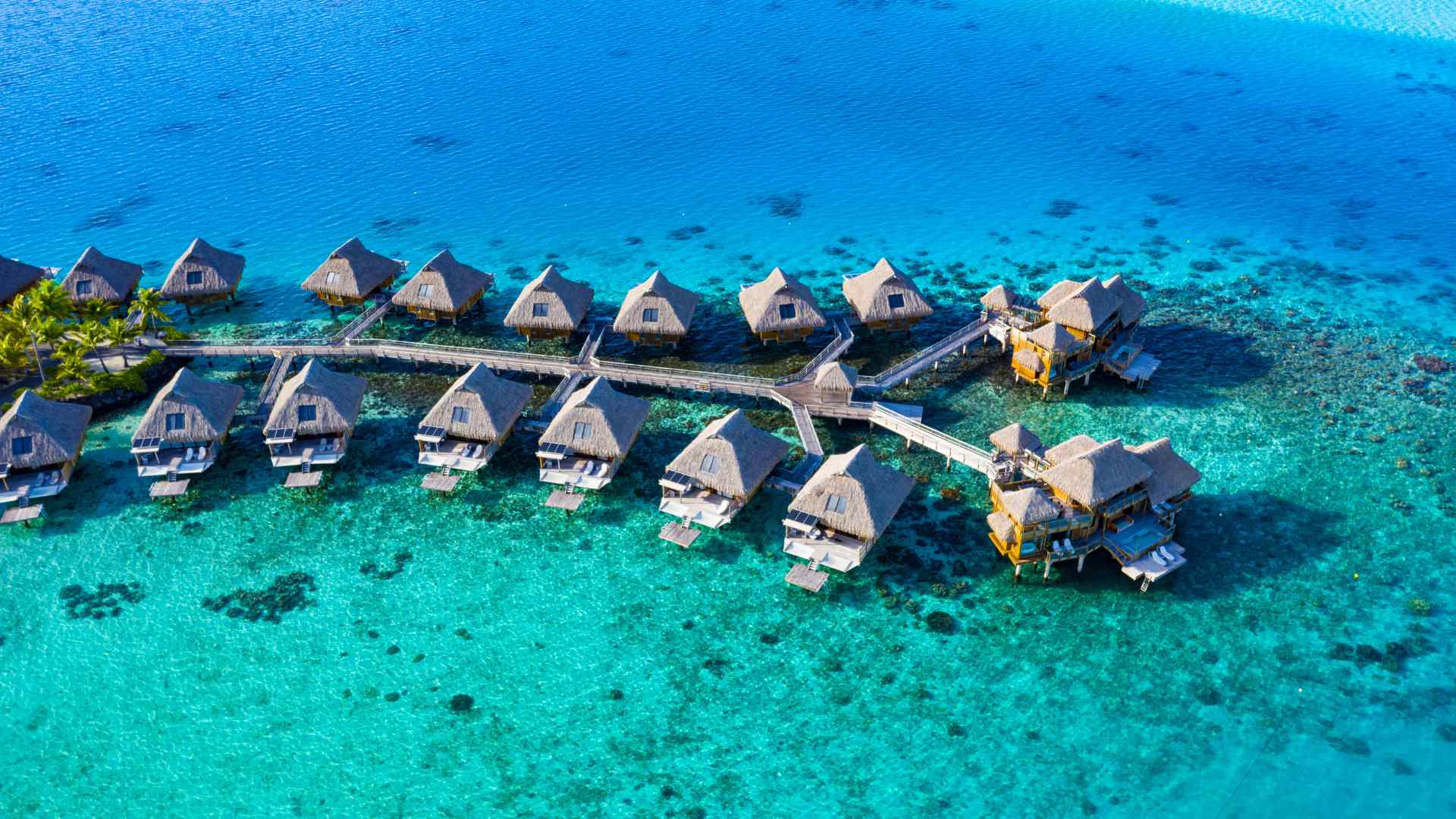
A broad sandy lagoon can look spectacular while putting the reef edge farther from the villa ladder. A map can suggest where reef edges lie, but it cannot tell you current coral health or safe entry conditions.
Look for a dark ring close to the island. Dark patches might be reef, seagrass, or deeper water, while pale areas are often shallow sand.
Use the map as a starting point with my guide to judging a house reef.
Which Maldives islands would I book purely for the reef?
Ellaidhoo, without much hesitation, because the reef there is long, close and genuinely the reason the resort exists. My guide to the reef-first water bungalows at Ellaidhoo covers what the room itself is and is not.
Kandolhu is the one I recommend to people who want the reef without the roughness. It is a small island with a wall close in, and the villa steps put you in it directly.
Angaga and Filitheyo are the value versions of the same argument. Both are older Ari and Faafu atoll islands with the reef right there and no pretense about anything else.
If you want the reef and the polish together, Six Senses Laamu is the one I would pick. Read my take on whether the pool villa at Laamu is worth it, because the answer depends entirely on whether you plan to be in the ocean instead.
For a wider set of comparisons, start with my head-to-head of ten Maldives resorts and filter for the ones that mention a house reef instead of a lagoon.
Where do I go if I want reef above everything else?
Raja Ampat, and it is not close. Water cottages at Misool, Kri Eco Resort, Papua Explorers, and Papua Paradise offer access to the extraordinary marine diversity of Raja Ampat.
The tradeoff is honest and severe. You will travel for two days each way, the rooms are simple, and the electricity may run on a schedule.
My write-up of the water cottages at Misool is the clearest picture of what that trip actually feels like. Sabah is the slightly easier version, with Sipadan-Kapalai and Mabul Water Bungalows built as dive bases above reef.
One planning note that matters. Sipadan diving runs on a permit system with daily limits, so the number of days you actually get in that water is set by paperwork, not by your booking.

How do I verify a house reef before I pay for it?
Ask the reservations team four specific questions, and pay attention to whether they answer or deflect.
- How far is the reef edge from the water villa jetty? A good answer is a distance. A bad answer is “very close”.
- Can I enter directly from the villa, or is entry only from a designated point? Many reef resorts restrict entry for safety and reef protection, which is fine, but you want to know.
- What happens at low tide? Ask specifically whether the reef flat is walkable, because that is a bruised-shin situation nobody warns you about.
- Is there a current advisory, and are fins or a vest required? Resorts with a real drop-off usually have a rule, and the presence of a rule is a good sign.
Then go find recent guest photos rather than the resort gallery. Coral cover can change after a bleaching event, and marketing images may stay online for years.
You can also check NOAA Coral Reef Watch for regional heat stress, though it does not show the exact condition of a resort reef.
What goes wrong on a great house reef?
This is the part I want you to take seriously, because a good reef is not a safe reef. The best house reefs sit next to drop-offs and channels, which means moving water.
A current can carry swimmers past the end of an island without much warning. Follow the resort’s snorkeling guidance and avoid swimming against a strong current.
Fire coral and stonefish live on these reefs too, and the reef flat at low tide is where people cut their feet. Reef shoes are not a fashion failure, they are a functional item.
Go in with fins, a flotation vest if you are at all unsure, and someone who knows you are out there. My piece on snorkeling straight off a villa ladder covers the rest of it properly.
Who should skip a house reef resort entirely?
Weak swimmers, first of all. A reef-edge resort is the wrong place to learn, and a wide calm lagoon is genuinely the better booking for you.
People traveling with small children, second. A shallow or rocky entry that may accompany reef snorkeling makes the shore entry unfriendly for a four year old.
And anyone whose real plan is a pool, a book and a spa. You will pay a premium for water you never enter, and you would be happier at a lagoon resort with a nicer room.
I would also skip the reef-first islands in the deep low season, when visibility drops and the wind puts sediment in the water. A perfect reef in bad conditions is just gray soup.
The questions that come up every time
Can I snorkel straight off my overwater villa?
At many resorts yes, but a surprising number restrict entry to designated points for safety or reef protection. Ask before you book, because a villa ladder into a marked no-entry zone is a common and very annoying surprise.
Is a house reef better than taking a snorkeling boat?
For frequency, absolutely, because you go three times a day instead of once. A boat trip usually reaches better sites, so the ideal resort has a decent house reef and a good excursion program rather than one or the other.
Do I need to be a diver to enjoy one?
No, and most of the best house reef moments happen in eight feet of water with a mask. Diving opens up the wall and the deeper structure, but the fish density is highest near the top anyway.
Which month has the clearest water?
Generally the dry season in whichever region you pick, since calm wind means less sediment and better visibility. Ask the resort dive center about the specific weeks you are considering, because local conditions vary more than a regional average suggests.
Are house reefs recovering from bleaching?
Recovery varies enormously by site, and I would not trust any blanket claim in either direction. Ask the resort dive center what the reef looked like in the last few months, since they are in that water daily and usually straightforward about it.
If you only remember one thing
Book the reef, not the room. A plain water villa on a living reef will give you a better week than a spectacular villa above sand, and it usually costs less.
Pale turquoise often signals shallow sand, which can still be lovely for swimming even when reef snorkeling is your priority. That is the whole trick in one sentence.
So look at the water in the picture, and then ask what makes it that color. The answer may include sand, seagrass, coral, or a mix, and it changes what you can do from your villa.
Reef conditions, entry rules, and dive-center policies can change. Ask the resort for recent reef photos and the current swimming guidance before booking around snorkeling.