
Caribbean vs Indian Ocean Overwater: Flight Time, Cost, and Water Compared
These two overwater regions get compared as if they were rivals. They are not.
From many U.S. gateways, the Caribbean can mean a shorter journey. Compare the actual flight and final transfer, then judge water clarity at the specific resort rather than by ocean.
Caribbean vs Indian Ocean overwater, in 30 seconds
- Trip under six nights: Caribbean. The travel days do not fit anywhere else.
- The reef matters most to you: Compare the actual house reef and safe entry point at each resort.
- You want to leave the property: Caribbean. Most villas sit near a road, a town, or a larger resort.
- You want a hard cap on how many people are around you: an Indian Ocean island resort, where the villa count is the population.
- You are sitting on hotel points: Indian Ocean, where cash rates run highest and a redemption is worth most.
- Fixed budget, short calendar: Caribbean, and put what you save into extra nights.
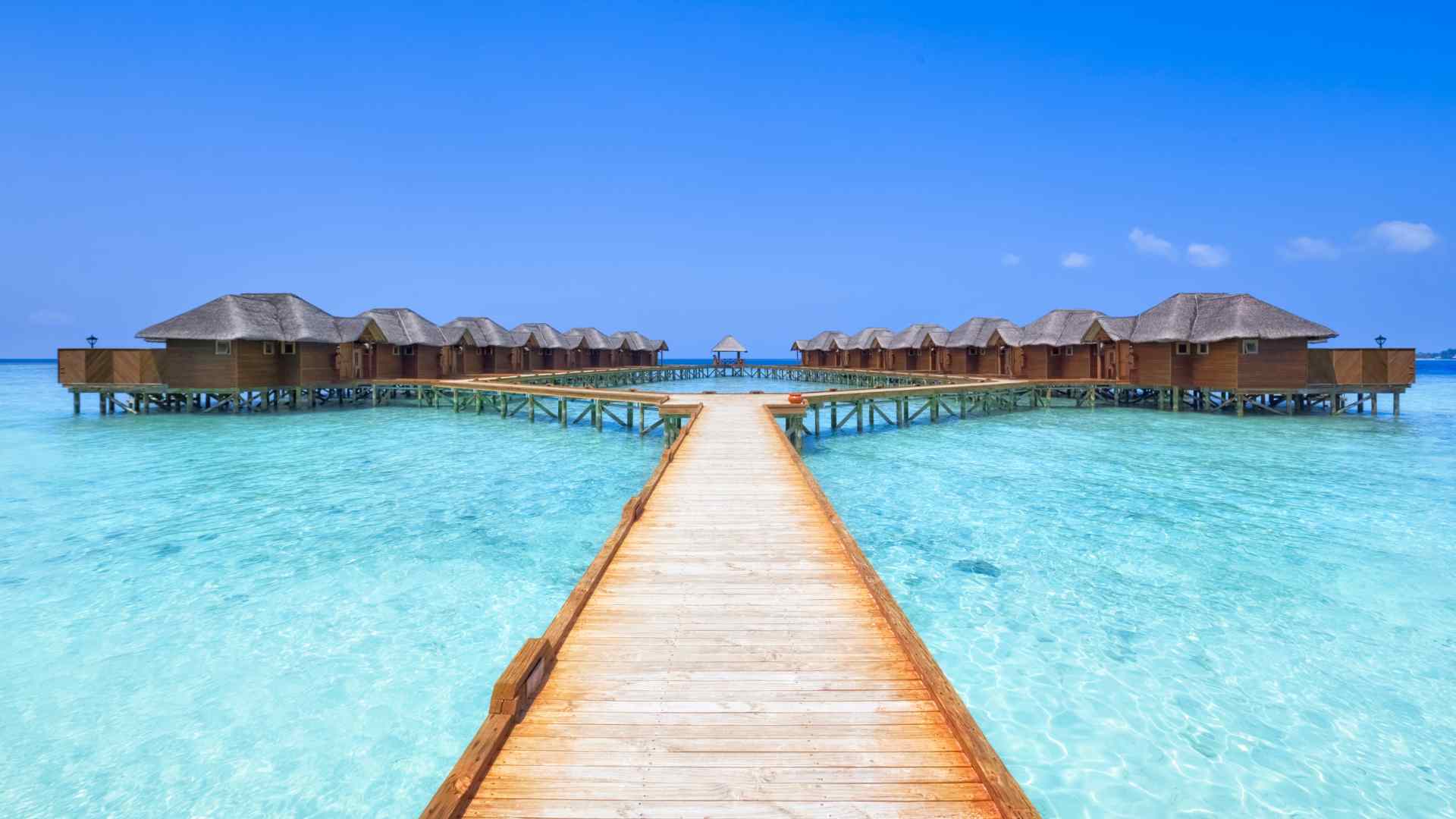
Travel time: compare your gateway and the final transfer
From some U.S. gateways, a Caribbean overwater stay can be one flight and a short transfer. Check the actual connection from your home airport before assuming you will reach the villa the same day.
The Indian Ocean is not that. You are connecting through a large hub, crossing many time zones, and then taking a boat or a small plane on top of that.
What you give up in the Caribbean is nothing on this row. This is the clearest win in the whole comparison.
What it means in practice is that a Caribbean overwater stay works as a five night trip. An Indian Ocean stay really does not.
Two days of your Maldives week are travel days, and pretending otherwise is how people end up exhausted and disappointed. Plan the nights around that, not around the villa photos.
Jet lag: a real line item that nobody budgets for
The time change is often smaller from eastern North America to the Caribbean than to the Indian Ocean. From western gateways, check the actual time-zone difference before treating jet lag as a minor detail.
Flying to the Indian Ocean flips your day around. The first two mornings you are up before sunrise, and the first two evenings you are asleep before dinner.
Here is the part nobody puts in the brochure. If you book a short Maldives trip, jet lag eats a meaningful share of it.
The workaround is length, not supplements. Nine or ten nights absorbs the adjustment, and five nights does not.
The water: choose the reef and villa position, not a region
I want to be fair to the Caribbean here, because the Caribbean has spectacular water. But the two are not competing on the same axis.
A Maldives resort can place you near a reef, but a blue lagoon does not guarantee good snorkeling from the villa. Compare the exact swimming zone and reef access; Six Senses Laamu’s lagoon villa is a useful example of shallow water with a separate choice of ocean-facing rooms.
Some Caribbean water villas sit over sand or seagrass, but the region also includes access to the Belize Barrier Reef. Ask about the water immediately below your own villa and how you reach the best reef.
That is a design choice, not a failure. Calm shallow water is safer, easier to build in, and better for people who are nervous swimmers.
It also changes what your ladder does. At low tide, a Caribbean villa ladder can lead into waist-deep water or onto sand.
Ask about depth at your exact room before paying extra for direct entry.
On a reef island the opposite risk applies. The drop off can start close enough to the villa that the depth and the current both change inside of thirty feet.
So if snorkeling is the reason you want an overwater villa, be careful in the Caribbean. Read how to judge a resort house reef and then ask the resort directly what is under the villa.
Ask for a photo taken from the villa ladder this year. A rendering is not an answer.
Arrival day: one region gives you a day back
In the Caribbean, arrival day is usually a real day. You land, you drive or boat for a while, and you are swimming by afternoon.
In the Indian Ocean, arrival day is a logistics day. There is a hub connection, a customs line, a transfer desk, and then a wait in a resort lounge for whatever boat or plane is taking you onward.
Which craft you get matters more than people expect. Islands close to the airport run a speedboat or a dhoni and can move you after dark, and seaplane islands cannot.
The seaplane cutoff is set by daylight, not by the resort, so a late landing can cost you the villa entirely on night one. That is a genuine expense and a genuine mood killer.
Transfer schedules and the last departure of the day shift with the season, so confirm your specific transfer window with the resort once your flights are ticketed. Do not assume the times you read last year still hold.
The fix is to build your itinerary backward from the transfer, not forward from the cheapest flight. Book the earlier arrival even when it costs more.
Price: what looks cheaper often is not
People assume the Caribbean is the budget option because the flight is cheaper. Sometimes it is, and often the nightly rate erases that gain.
Caribbean overwater inventory is genuinely scarce. Scarcity keeps rates high, and there is no low tier equivalent the way there is in the Indian Ocean.
The Indian Ocean has the opposite shape. Expensive to reach, but with resorts at every level once you are there.
The quoted rate is also not the rate in either region. A service charge, a government tax, the transfer, and your meal plan all land on the final bill separately.
Half board sounds like a saving until you price dinner drinks on a private island with one bar. Ask for a written all in quote covering taxes, transfers, and the meal plan before you compare anything.
So the honest framing is this. The Caribbean has a cheaper entry cost and a similar or higher nightly cost, while the Indian Ocean has an expensive entry cost and a much wider nightly range.
If you want to see how those pieces stack into one number, our breakdown of the true cost of an overwater vacation walks through the parts people forget. Transfers and meal plans are the two that surprise everyone.
Flexibility: the Caribbean gains, and you give up isolation
Caribbean overwater resorts are usually attached to something. There is a mainland, a road, a town, and often a larger resort behind the villas.
You can go out to dinner, take a day trip, or change your plans on a Tuesday. That is worth real money to some people.
It also means noise, day guests, boat traffic, and neighbors. Your overwater villa may look out at a busy shoreline rather than open ocean.
The St Lucia villas are the clearest example of the whole tradeoff in one place, and our walkthrough of the Sandals Grande St Lucian water villas covers what is shared and what is not. Read it before you assume exclusive means private.
Indian Ocean resorts trade that away entirely for privacy. One island, one property, no road.
Which of those you want is a personality question, not a quality question. I would ask yourself how you feel on day four with nowhere to go.

Weather risk: you give something up in both places
The Caribbean has an Atlantic hurricane season running June through November, with the greatest activity often later in summer and early fall. Rates drop for a reason.
You can travel then and often be completely fine. You can also lose a trip, and you should carry insurance if you go that route.
The Indian Ocean has a wetter monsoon stretch instead. That rarely cancels a trip, but it changes the water clarity and the sea state.
You feel that most on the house reef, where a stirred up lagoon can cut visibility to a few feet for a couple of days at a time. The villa is fine, and the reason you came is not.
The practical difference is the shape of the risk. One region risks the whole trip occasionally, and the other risks the quality of individual days routinely.
Check your dates against the month by month overwater weather calendar before you commit to nonrefundable rates. Then decide how much risk you actually want to hold.
Crowds and privacy: a quieter tradeoff
An Indian Ocean island resort has a hard cap on how many people can be there. That number is the villa count, and it does not move.
Caribbean overwater villas are frequently bolted onto a much larger property. The villas are exclusive, and the beach, the buffet, and the pool decks often are not.
That is fine if you plan to stay on your deck. It is a problem if you pictured an empty stretch of sand and got a crowded one.
Ask two questions before booking a Caribbean villa. How many total rooms are on the property, and which facilities are shared with them.
Room counts change when a property adds a wing, so get that number from the resort rather than from an old review. The answers change the trip more than the villa category does.
Points and miles: an underrated tiebreaker
If you have a stash of hotel points, the calculus shifts. Both regions have properties inside major loyalty programs, and both have plenty that are not.
The Indian Ocean tends to reward points more, simply because cash rates go so high. Redeeming against a very expensive night is where points earn their keep.
The Caribbean is often better for airline miles instead, because the flights are short and award availability is broader. That is a smaller win, but it is a real one.
One warning. Award nights frequently do not include the transfer, and a seaplane seat is a cash charge no matter how you paid for the room.
The ledger, summarized
- Caribbean gains: Short flights, no jet lag, easy short trips, the option to leave the property.
- Caribbean gives up: Reef quality at many resorts, true isolation, and any real budget tier.
- Indian Ocean gains: Water and reef, privacy, a huge range of price points, better points value.
- Indian Ocean gives up: Two travel days, jet lag, and the ability to change your mind mid trip.
Look at that list and notice something. Almost none of it is about the villa itself.
The villas are more alike than different across both regions. Everything that will actually shape your week happens outside the room.
Fast answers
Is the Caribbean overwater experience a watered down version?
No, it is a different product rather than a lesser one, and the villas themselves are often newer and better built than their Indian Ocean equivalents. What you give up is what sits underneath them, because many Caribbean villas are built over sand or seagrass instead of live reef.
Where are Caribbean overwater villas actually located?
They are scattered across a handful of countries rather than concentrated in one place, so you shop by individual property instead of by destination. Our guide to every Caribbean overwater resort is the fastest way to see what exists right now.
Can I get an all inclusive in both regions?
Yes, but the Caribbean does it better and more consistently, because all inclusive is the default business model there rather than an add on. In the Indian Ocean you are usually choosing between half board and full board, and our notes on what all inclusive really covers over water explain where the gaps are.
Which is better for a first overwater trip?
The Caribbean, if you are not yet sure you will like sleeping over water, because it is a much cheaper experiment with far less travel attached to it. If you already know reef snorkeling is the point of the trip, skip the trial run and go straight to the Indian Ocean.
Do I need to be a strong swimmer?
No, not in either region, though the shallow protected Caribbean lagoons are far more forgiving if you are nervous in open water. Indian Ocean villas often sit near a reef drop off, where the depth and the current can both change within a few strokes of the ladder.
How many nights should I book in each region?
Four to six nights works in the Caribbean, because arrival day is a usable day and departure day usually is too. In the Indian Ocean I would not go under seven, and nine is where the trip finally stops feeling like a commute with a view.
Where I would spend the money instead
If your trip is under six nights, stop looking at the Indian Ocean. You will spend a third of it in airports and airport hotels.
Book the Caribbean, take a lesser villa category, and put the savings into a longer stay. That is the trade that actually pays.
If you have nine nights or more and you care about what is under the water, go the other way. Fly the long way, book a resort with a real reef, and skip the private pool entirely.
The mistake I see most often is a short trip to a far place in an expensive villa. Reverse all three and you get a much better week.
Nobody has ever told me their trip was ruined because the villa was too plain. Plenty of people have told me it was too short.
Transfer times, meal plan structures, and room counts move around more than resorts admit. I keep this comparison current, but get the specifics in writing from the property before you put money down.