Private Island Resorts vs Resort Islands: The Difference That Costs Thousands
A private-island label can hide very different levels of access and privacy. Check what the quoted rate actually includes before paying more for it.
Private island vs resort island is mostly a marketing distinction. Here is where it stops being one.
What you need to know
In the Maldives, many resorts occupy a whole island while still hosting other guests; elsewhere, overwater rooms can sit on shared or mainland sites. Confirm whether “private island” means exclusive use, resort-only access or simply an island setting.
- Usually identical: one resort, one island, no day trippers, dozens of other guests.
- Actually different: exclusive use or a whole island buyout, priced per island per night.
- What changes your week: villa spacing, house reef quality, and who controls the schedule.
- What does not: the word private on the booking page.
“Private island” means I get the island to myself
Aitutaki describes its private-island arrangement and overwater category separately. Read both before deciding what the word private buys you.
Almost never. In most of the destinations people book for an overwater stay, one resort sits on one island, and the marketing team calls that a private island resort.
It is private in the sense that no day trippers wander through and no unrelated hotel shares your beach. It is not private in the sense that you and forty other couples are not all queuing for the same espresso machine at eight in the morning.
That is the whole trick. A resort island and a private island resort are usually the same physical thing described with different confidence.
The genuinely exclusive product has a different name on the rate sheet. It is sold as exclusive use, whole island buyout, or a standalone private residence with its own staff, and the price is quoted for the island rather than per villa.
If the booking page lets you reserve one villa for two people, you are not buying an island. You are buying a room on one.
A resort island is the budget compromise
I would flip that around. A single resort occupying a whole island is the standard format, not the fallback, and excellent snorkeling can be available at a larger resort too.
Scale buys you things that small properties genuinely struggle to fund. More restaurants, a dive center that runs twice a day instead of when someone feels like it, a spa with more than one therapist, and a kids club if you need one.
Scale also buys you redundancy. When the sunset cruise is full or the one chef with a night off has closed the only restaurant, a bigger island still has somewhere to send you.
A small island with one kitchen can have limited late-night dining. Check meal times if you expect to return from an excursion after dinner.
The tradeoff is texture. Big islands have staff turnover, service that resets every time a new person greets you, and a faint feeling that you are a room number.
Small islands remember your drink order by day two. Whether that is worth several thousand dollars is a real question and not a rhetorical one.
Fewer villas always means more privacy
Villa count on its own tells you very little. What matters is villas divided by usable shoreline, and nobody advertises that number.
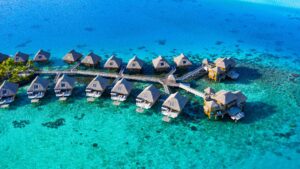
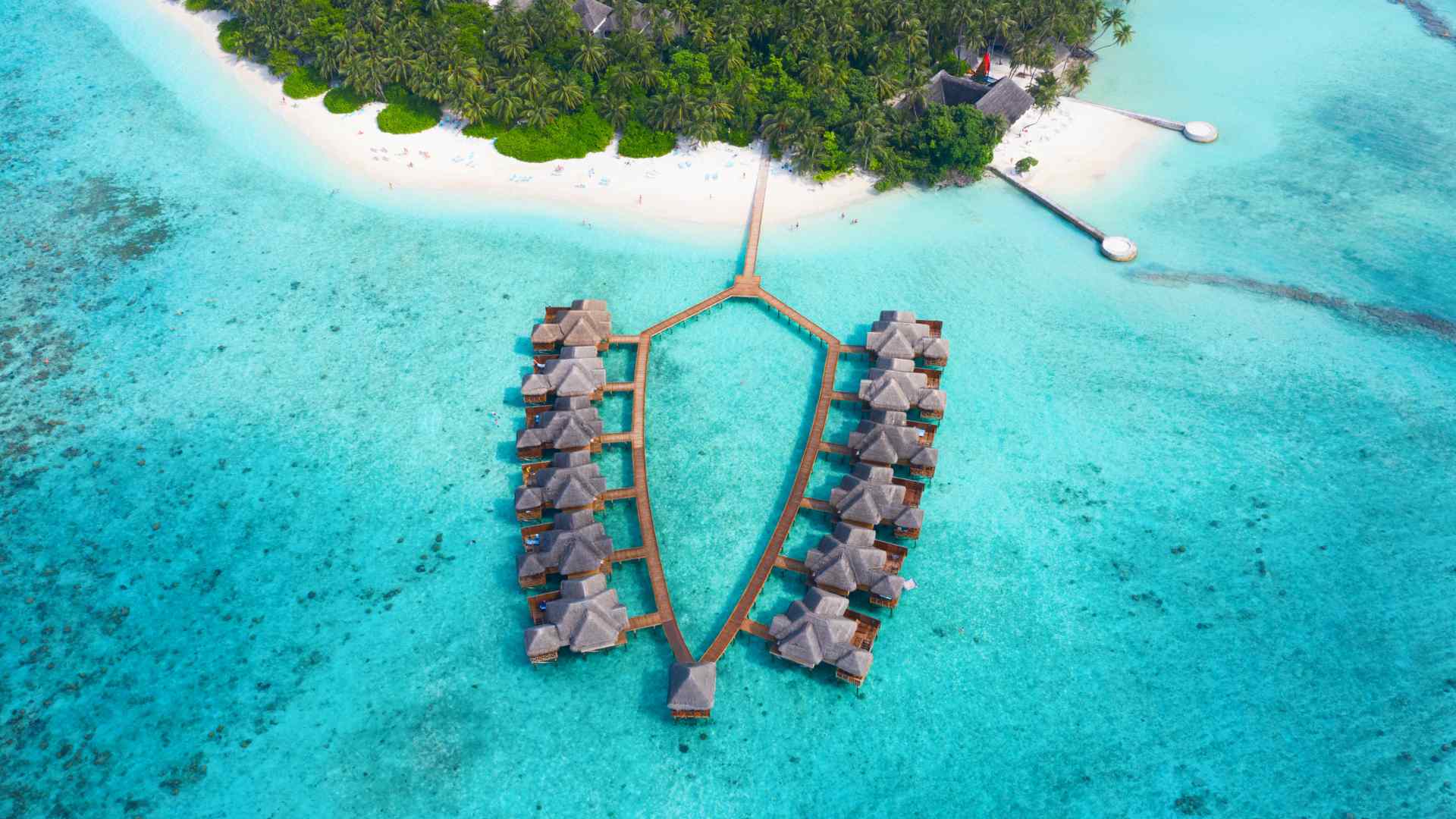
A property with thirty villas packed onto one short jetty can feel more crowded than one with a hundred and twenty spread across four separate arms of a big lagoon. Ask about the spacing between decks before paying extra for privacy.
Look at the satellite view before you look at the villa count. Count the jetties, look at how far apart the roofs are, and see whether the walkways run past your deck or behind it.
A stylized resort map may make neighboring villas look farther apart than they are. Check recent aerial photographs and ask the property about the exact villa position.
Then ask the reservations team one specific question. Which villa numbers on this jetty have no neighbor on at least one side, and are any of those available for my dates.
That question costs nothing and does more for your privacy than any category upgrade. I go further on the mechanics of it in my guide to picking a villa position on the jetty.
The private island premium buys better water
It buys fewer people in the water. It does not buy a better reef, and those are completely different products.
Reef quality is a function of geography, depth, current, and how the island was built. A tiny exclusive property dredged onto a sand flat can have nothing to snorkel over, while a large resort on an old natural island can have a wall of coral thirty feet from your ladder.
Price correlates with exclusivity, not with marine life. That is the single most expensive misunderstanding in this category.
If the water is the reason you are going, vet the reef before you vet the room. My method for that is in how to judge a resort house reef, and it works the same whether the property has twelve villas or two hundred.
Ask for a recent guest photo taken underwater, not a drone shot. Drone shots make dead sand look like a postcard.
You can buy the private island feeling with a villa upgrade
Sometimes, and much more cheaply than people expect. The end villa on the far arm of a big resort is often the quietest room on the island, and it is usually not the most expensive one.
What an upgrade cannot fix is the island itself. If the main pool is loud, the pool is loud from every villa within earshot, and no category change moves the pool.
So decide which kind of quiet you actually want. Quiet at the villa is buyable for a few hundred dollars, while quiet across the whole property is a different resort entirely.
This is also where the smaller boutique properties earn their money. They are not selling you a bigger room, they are selling you fewer strangers.

Exclusive use is only for celebrities and wedding parties
Mostly true, but not for the reason people think. It is not gatekept, it is just arithmetic.
A true buyout is priced against the revenue the property would have made selling every villa, plus staffing. Split across a group of two, that is absurd, and split across sixteen adults it can land closer to a very good suite each.
The small private island properties that sleep eight to twelve people are the interesting middle. They are not cheap, but they are not the fantasy number either, and for a milestone birthday with several couples they occasionally beat booking the same number of villas at a big resort.
Buyout pricing is the most volatile thing in this whole post, and it is never published. You have to email the property with your exact dates and group size, and the quote you get in March will not be the quote you get in June.
The catch is that everything becomes your problem. Food preferences, boat schedules, and what happens when one couple wants a dive day and another wants to sleep in.
Groups who love it are groups who already vacation together well. Groups who are trying it to fix something usually do not fix it.
The difference between the two is mostly about privacy
Privacy is the marketing story. Control is the real difference.
On a resort island you fit into a schedule. Breakfast ends at ten, the boat to the sandbank leaves at two, and the restaurant you wanted is dark on Tuesdays.
Half board at a big property is built around that schedule too. You get a fixed dinner allowance at set restaurants on set nights, and stepping outside it is where the bill quietly grows.
On a genuinely private island, the schedule is whatever you say it is. Dinner at nine because you fell asleep, a boat at dawn because someone wants to fish, no set menu and no other tables.
Ask yourself honestly whether you use that kind of control. Plenty of people pay for total flexibility and then eat dinner at seven every night like everyone else.
If that is you, the money is better spent on nights, on a longer trip, or on a better villa position. I break down where the real spending goes in the true cost of an overwater vacation.
The upcharge is a fixed thing you can compare
It is not fixed and it moves more than the room rate does. The gap between a mainstream resort island and a small exclusive property widens hard in peak season and narrows in shoulder months.
Small properties have fewer villas to fill, so they discount later and less predictably. Big properties run promotions on a calendar because they have inventory to move.
Practically, that means the comparison you ran in January may be wrong for a September trip. Reprice both for your actual dates instead of trusting a number you saw once.
And compare the all-in total, not the nightly rate. Transfers, service charge, meal plans, and green taxes swing this comparison more than the room does, especially at properties reached by a longer boat or seaplane leg.
A remote island may add a substantial transfer charge for two people. Get the exact round-trip amount before comparing room rates.
Seaplane transfers also come with a daylight cutoff, so a late arriving flight can strand you in an airport hotel for a night. Ask the resort what happens to your first night if you miss the last plane, and get the answer in writing.
Who should skip the private island premium entirely
Anyone going for under six nights. The small property charm takes two or three days to register, and by then you are packing.
Anyone whose main reason for the trip is snorkeling or diving. Spend that money on a resort with a real house reef and a dive center that runs on a schedule.
And any family with children. Fewer guests means fewer other kids, no kids club, and a much shorter list of things to do when the weather turns.
The honest downside of the small exclusive island is monotony. One kitchen, one bar, one beach, and no way to change your mind for a week.
Things people ask me about private islands
Is a smaller island always quieter?
No, and it frequently works the other way around. Small islands funnel every guest into one restaurant, one bar, and one stretch of beach, so a single loud table sets the tone for the entire property in a way it never could on a larger island.
Do private island resorts have better food?
Better sourcing sometimes, less variety almost always. A very small island typically runs one kitchen and one menu on a short rotation, which feels generous for four nights and becomes a genuine test of your patience somewhere around night nine.
Can I get exclusive use of just one jetty?
At some properties yes, and it is always worth asking. Booking a block of adjacent villas on a single arm gives a group its own stretch of water for far less than a full buyout, though availability moves constantly, so ask the reservations team early.
Are private island properties better for families?
Usually the opposite, because small islands have less for children to do and fewer places for a family to spread out. The adults only versus family friendly question matters far more here than the villa count on the brochure does.
Is the term private island regulated anywhere?
The phrase alone does not tell you who else can use the island. Confirm guest numbers, day visitors, shared facilities and exclusive-use terms before paying a premium.
The short version
Many Maldivian overwater resorts occupy an island, but that does not grant exclusive use and the pattern differs elsewhere. Compare privacy, villa spacing, reef quality and schedule control before paying more.
If you want fewer people, buy a smaller property and accept a shorter menu. If you want better water, ignore both labels and vet the reef.
And if you want a true buyout, get at least six couples in the room before you get a quote. Everything else is a very expensive adjective.
Villa counts, buyout pricing, and transfer schedules all shift from season to season. I keep this guide current, but check the specifics with the property before you put money down.