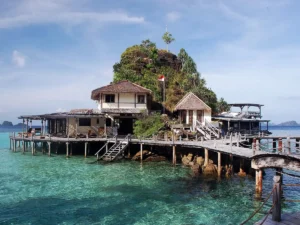
The Overwater Villa Map Trick: How to Pick Your Perfect Jetty Spot
The prettiest overwater villa on the resort map can still be the wrong one for you. A tiny choice between the jetty’s beginning, middle, and far end can decide whether your trip feels blissfully private or like a very expensive daily step challenge.
Choosing an overwater villa position in 30 seconds
- Standout: Villa position changes privacy, walking time, water conditions, boat noise, and the view far more than many glossy room photos suggest.
- Best for: Anyone choosing a specific villa number, paying for a location upgrade, or emailing a resort with a room request.
- Biggest catch: The farthest villa is not automatically the quietest, and the deepest-looking water is not automatically the safest for swimming.
- My pick: A middle-to-outer villa on the sheltered side, away from arrival traffic, usually gives the loveliest balance of privacy and convenience.
Before falling for an end-of-jetty sunset photo, open the resort map and compare it with the practical questions in our overwater bungalow planning guide. I would rather have a slightly less dramatic map pin with calm water and an easy breakfast walk than win the jetty beauty contest and regret it by day two.
Start with the holiday you actually want
There is no universal best villa position because people want different versions of paradise. Honeymooners may happily trade a longer walk for privacy, while a parent, a traveler with limited mobility, or anyone who pops back to the room often may love the first third of the jetty.
Write down your top three priorities before studying villa numbers. If your list says quiet mornings, easy snorkeling, and sunset, you have a useful filter; if it just says best villa, every sales description will sound equally persuasive.
Treat the jetty like a tiny neighborhood
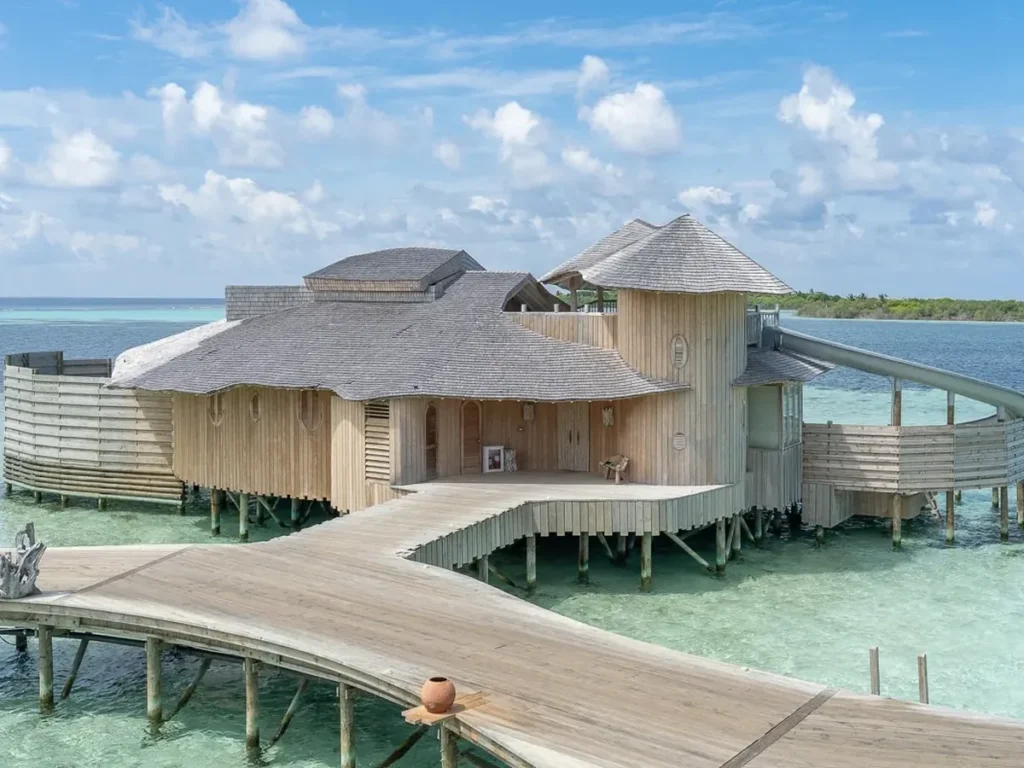
The shore end is the convenient neighborhood, the middle is the compromise neighborhood, and the outer end is the private neighborhood with a longer commute. That framing is simple, but it stops the common mistake of assuming that farther from land always means better.
Also look for side spurs, bends, service platforms, restaurants, arrival docks, and water-sports huts. Two villas the same distance from shore can feel completely different if one faces a quiet lagoon and the other watches supply boats make their morning rounds.
Shore-end villas are wonderfully underrated
A villa near the island can shave real time off every breakfast, pool, spa, and reception trip. That matters more than it sounds when the sun is fierce, the jetty is wet, or you realize your sunscreen is sitting beside the bed just as the excursion boat is boarding.
The tradeoff is usually more foot traffic and a greater chance of hearing beach activity, carts, restaurants, or evening entertainment. Shore-end water may also be shallower or more affected by sand, seagrass, and the island’s shape, although the exact pattern is resort-specific.
This zone is often my first suggestion for travelers who value easy logistics, have knee or balance concerns, travel with young children, or simply dislike organizing every outing like a small expedition. Our overwater villa accessibility checklist has the questions worth sending before you book.
Middle-jetty villas often win the balance test
The middle is rarely marketed with the same drama as the last villa over the horizon, yet it is often the sensible sweet spot. You gain separation from shore without turning every coffee refill into a hike, and there may be several water-entry options nearby.
Middle villas can still have neighbors passing throughout the day, especially if every outer villa shares the same route. Study whether your deck faces the walkway, the open lagoon, or another row of decks, because orientation can matter more than raw distance.
Outer villas bring privacy, plus a few gotchas
At the far end, the horizon may feel enormous and the island wonderfully remote. You may also get stronger wind, more movement in the water, less shelter during rough weather, and a surprisingly long walk when it is raining sideways.
The final villa is not automatically silent. Generator hum, staff docks, seaplane lanes, excursion routes, and channel markers can all sit beyond the guest-facing map, so it is worth learning what operates near the outer end and at what times.
Outer positions make the most sense for travelers who genuinely prioritize privacy and do not mind distance. If you expect to use the main pool, kids club, buffet, or spa several times a day, convenience may create more happiness than a theoretically superior horizon.
Pick the side of the jetty as carefully as the distance
The two sides of one walkway may receive different sun, wind, views, and boat traffic. A deck facing the island can feel sheltered and colorful, while the opposite side may feel wide open but receive more swell or a less forgiving afternoon breeze.
Sunrise and sunset orientation is the easy question; your own habits are the important follow-up. Sunset is romantic, but morning shade can be glorious if you plan to read outside after breakfast and would rather not slow-roast on the lounger.
Our sunrise versus sunset villa guide walks through that choice without pretending everyone keeps the same vacation schedule. I am firmly on team choose the deck you will actually use.
Water depth is useful, but it is not the whole swimming story
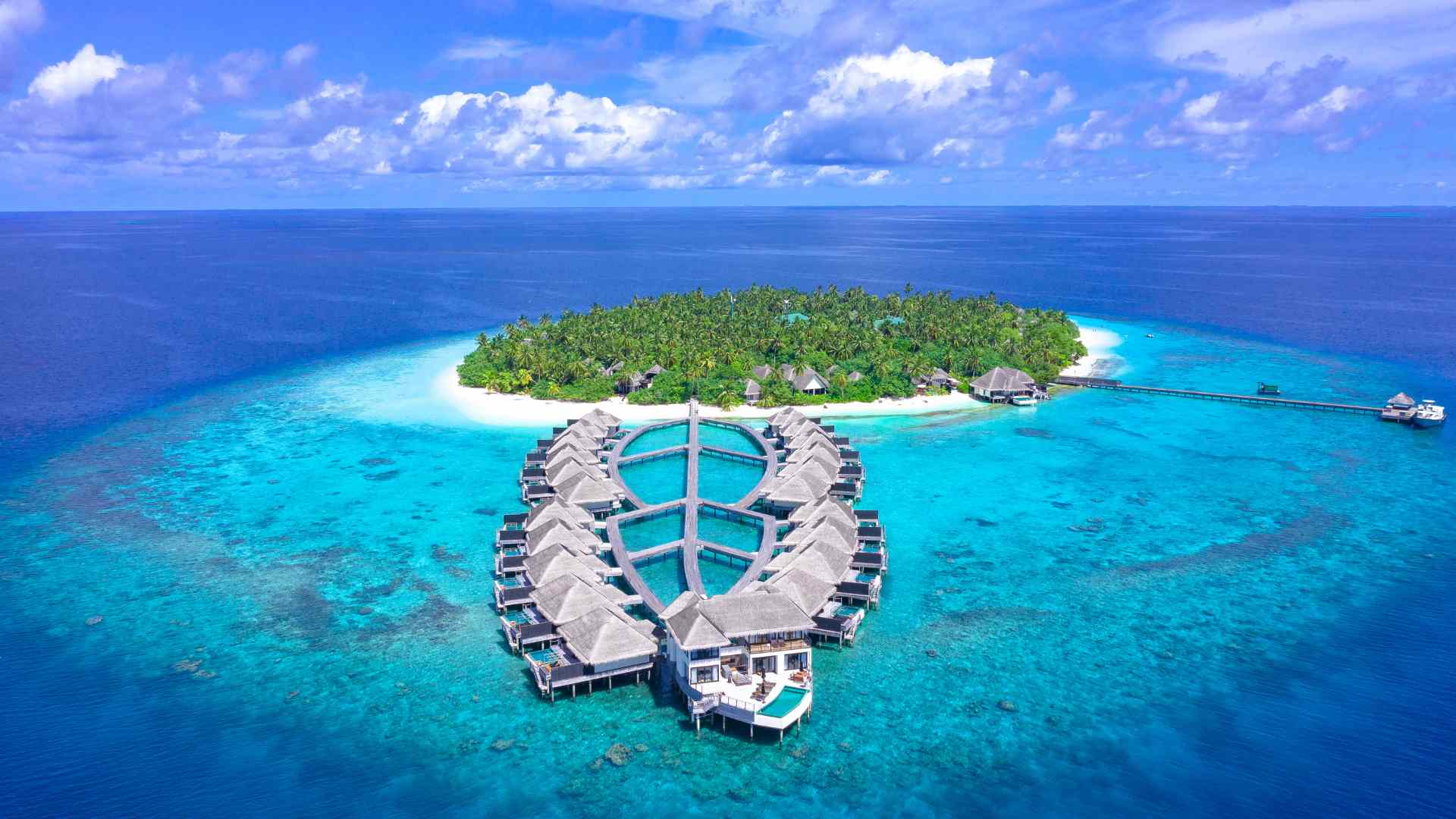
A darker patch on an aerial image may indicate deeper water, reef, seagrass, cloud shadow, or simply a different camera angle. It cannot tell you whether the current is comfortable, the ladder reaches usable depth, or swimming from that deck is permitted.
Tides change vertical water level, while currents describe horizontal movement, and the relationship between them varies by place. NOAA explains why tide and current predictions are separate, which is a helpful antidote to the idea that a high-tide time alone tells you how the water will behave.
The useful details are the usual swimming depth at low tide, the direction of current, the marked swim boundary, and whether coral or boat channels limit entry. Staff guidance for the exact villa always outranks a broad map interpretation.
House reef access can beat a perfect postcard view
If snorkeling is a priority, find the designated house-reef entrances and exits before choosing a villa. The best coral may be reached from a communal platform rather than your private ladder, and a gorgeous shallow deck may sit far from the safe route through the reef.
Our house reef guide separates easy access from vague claims about abundant marine life. NOAA’s coral reef etiquette is also worth reading before the trip, especially the guidance to keep hands and fins off coral.
Privacy is about sightlines, not just spacing
A villa can be far from shore and still expose its deck to every passerby if the path curves around it. Conversely, a nearer villa with a side-facing deck, planting, a privacy screen, or a staggered footprint may feel wonderfully tucked away.
Look at guest photos for deck-to-deck sightlines, but remember that wide-angle lenses can distort distance. Ask whether neighboring decks face each other and whether boats routinely pass the private pool or ladder, using neutral language rather than demanding a villa with total privacy that may not exist.
Noise has more sources than the next-door villa
Restaurants, bars, live music, pools, staff paths, baggage carts, desalination equipment, and arrival docks all create different sound patterns. A resort can be quiet overall while one small stretch of jetty wakes early with operations.
Seaplanes are brief but unmistakable, while transfer boats may be less dramatic and more frequent. Ask about the first and last scheduled movements near the villa area, then decide whether the convenience of a nearby dock is worth the soundtrack.
Weather changes the personality of a location
The breezy side can be heavenly in warm, settled weather and less appealing when wind pushes spray onto the deck. The sheltered side can make swimming feel calmer, but it may also feel hotter or attract more insects at certain destinations.
A forecast is more useful than a seasonal slogan because wind and short-term conditions matter. The National Weather Service water-safety guidance is written for beaches, yet its central lesson travels well: local warnings and real conditions deserve more trust than how inviting the water looks.
Do not pay for a label until you decode it
Names such as sunset, lagoon, ocean, reef, horizon, and premier are not standardized. One resort’s lagoon villa may be its calmest entry-level room, while another uses the same word for a view category with no meaningful location guarantee.
Room descriptions deserve a close look for orientation, pool, deck, ladder, maximum occupancy, and location range. If position is the only difference between two expensive categories, request a current map showing exactly which villa numbers belong to each one.
Make a request the resort can actually use
A polite ranked request works better than asking for the best room. Try: quiet location first, sheltered swimming second, and shorter walk third, then say you understand that the exact number is not guaranteed.
Contact the resort directly after booking and again shortly before arrival, especially when an outside booking channel cannot display the full villa map. Keep the request in writing, but treat it as a preference unless your confirmation explicitly guarantees the location.
If a particular feature is essential for safety or mobility, do not leave it as a casual request. Ask whether the hotel can confirm it in the reserved room category and what happens if that feature is unavailable.
My practical villa-position scorecard
I would score each possible zone from one to five for walking, privacy, swimming, view, sun, and noise, then double the categories that matter most to you. This is deliberately personal, because someone else’s perfect sunset villa can be your inconvenient, windy, boat-facing splurge.
- Choose the shore end for easy meals, short walks, and simpler logistics.
- Choose the middle for the strongest all-around balance of access and separation.
- Choose the outer end for horizon views and privacy when walking is not a concern.
- Choose the sheltered side when comfortable deck time and gentler conditions matter most.
- Choose near the approved reef entry only after confirming the actual swim route with the resort.
My default choice is middle-to-outer, on the quieter sheltered side, with no dock or service area nearby. I would happily move closer to shore for a traveler with mobility concerns, a family using central facilities, or a resort where snorkeling begins from a communal platform.
Frequently asked questions
Is the last villa on the jetty always the best?
No. It may have greater separation and a broader view, but it can also mean a longer walk, stronger wind, rougher water, or more exposure to boat and aircraft routes.
Should I choose a sunrise or sunset-facing villa?
Choose sunset for golden-hour deck time and sunrise for early light that often comes with afternoon shade. The better option is the one that matches when you actually expect to use the deck.
Can I request a specific overwater villa number?
Usually you can request one, but it is rarely guaranteed unless the number or exact location appears on the confirmed booking. Send two or three ranked priorities so the room team has useful alternatives.
Are shore-end overwater villas less private?
They can have more passing guests and activity, but deck orientation and screening may matter more than distance. A staggered shore-end deck can feel more private than an exposed outer villa beside a busy route.
How can I tell whether I can swim from my villa?
Direct entry is suitable only when the resort permits it and identifies usable depth, boat routes, and approved entry and exit points. A ladder in a photo confirms access hardware, not safe conditions.